Navigation | Category » Finance & Economics

Pages

Further Reading

June 12, 2009

fuel tax

Finance & Economics, Financial Crisis, In Other Words

(An interesting piece of analysis via TBP about rising gas prices crowding out retail and industrial consumption. The premise is sound but fails to acknowledge the already stimulative effect of a $2.50 decline in prices from their 2008 peak…)

As if the US consumer didn’t have enough to worry about, following the DOE data, the front gasoline contract is rallying to the highest level since Oct 15th ‘08. This morning, AAA said the national average for unleaded gasoline rose to $2.63, the most since Oct 28th ‘08, up from the recent low of $1.62 at the end of Dec. To quantify, the US uses about 9mm barrels of gasoline per day with 42 gallons in each barrel, thus 378mm gallons per day and almost 140b per year. Therefore, for every $1 move in the price of gasoline, it’s an extra $140b more in consumer spending at the pump. If gasoline prices stay elevated, it will dramatically dilute the tax cut portion of the Obama stimulus plan. On Feb 17th, Pres Obama signed the $787b stimulus plan that included $237b of ‘tax relief’ for individuals, $116b of which was a temporary payroll tax credit for income earners under a certain level.

DISCLAIMER

Although the information contained herein has been obtained from sources Miller Tabak + Co., LLC believes to be reliable, its accuracy and completeness cannot be guaranteed. This report is for informational purposes only and under no circumstances is it to be construed as an offer to sell, or a solicitation to buy, any security. At various times we may have positions in and effect transactions in securities referred to herein. Any recommendation contained in this report may not be appropriate for all investors. Trading options is not suitable for all investors and involves risk of loss. Although the information contained in the subject report (not including disclosures contained herein) has been obtained from sources we believe to be reliable, the accuracy and completeness of such information and the opinions expressed herein cannot be guaranteed. An options disclosure document may be obtained from Mr. Jay Stenberg, Miller Tabak + Co., LLC., 331 Madison Avenue, New York, NY 10017. Additional information is available upon request.

Member NYSE, NASD, CBOE, PHLX, ISE, NFA.

Member SIPC.

Filed by The Editor on June 12th, 2009

March 27, 2009

politico economicus

Finance & Economics, Financial Crisis

(In the midst of a global financial pandemic, private enterprise finds itself under the public microscope yet again — as it did during the 1930s after a century of unbridled growth and later in the 1970s after decades of stifling regulatory oversight. With this 21st century changing of the guard, the theoretical bases for free market capitalism are now under academic and legislative review. At the heart of the debate is the accuracy of the neoclassical economic models taught to college students around the planet as though they were immutable physical laws. Having some basis for estimating the future is clearly a useful if not interesting intellectual exercise, but building models and ultimately the entire financial system around half-baked calculus and thermodynamics seems like a dangerous over-simplification of modern commercial behavior.

In this eulogy to Homo economicus, the author explores the roots of political economy among thinkers like Smith, Ricardo, and Keynes, then describes how their keen sociological observations would never stand up to the quantitative rigors of modern economics. To be sure, there is certainly a place for analytical modeling and econometric analysis in framing our understanding of the world. But after a century of increased commercial, psychological, and informational complexity, maintaining a naive confidence in neoclassical methodology seems almost as “short-sighted” as the political economy it was originally designed to replace…)

Goodbye, Homo Economicus
by Anatole Kaletsky in Prospect

Was Adam Smith an economist? Was Keynes, Ricardo or Schumpeter? By the standards of today’s academic economists, the answer is no. Smith, Ricardo and Keynes produced no mathematical models. Their work lacked the “analytical rigour” and precise deductive logic demanded by modern economics. And none of them ever produced an econometric forecast (although Keynes and Schumpeter were able mathematicians). If any of these giants of economics applied for a university job today, they would be rejected. As for their written work, it would not have a chance of acceptance in the Economic Journal or American Economic Review. The editors, if they felt charitable, might advise Smith and Keynes to try a journal of history or sociology.

If you think I exaggerate, ask yourself what role academic economists have played in the present crisis. Granted, a few mainstream economists with practical backgrounds—like Paul Krugman and Larry Summers in the US—have been helpful explaining the crisis to the public and shaping some of the response. But in general how many academic economists have had something useful to say about the greatest upheaval in 70 years? The truth is even worse than this rhetorical question suggests: not only have economists, as a profession, failed to guide the world out of the crisis, they were also primarily responsible for leading us into it.

By “economists” in this context I do not mean the talking heads and commentators (myself included) employed by the media and financial institutions to explain the credit crunch or the collapse of house prices or the rise of unemployment or the movements of currencies and stock markets—usually well after the event. Neither do I mean the forecasters whose computer models churn out scientific-looking numbers on future growth or inflation, numbers that have to be revised so drastically whenever something “unexpected” happens (as it always does) that they are not really forecasts at all but descriptions of recent events. An IMF study of 72 recessions in 63 countries found, for example, that in only four of these cases had economic forecasters predicted a recession three months or more before the event. Economic forecasters and pundits cannot predict the future for the same reason that weather forecasters cannot predict the weather—the world economy is too complex and too susceptible to random shocks for precise numerical forecasts to have any real meaning.

This doesn’t mean that economics is useless, any more than unreliable weather forecasts should lead us to ignore Newton’s laws of motion, on which they rely. But economics should recognise that, as a discipline, it cannot be about predicting, but is instead about explaining and describing.

(more…)

Filed by The Editor on March 27th, 2009

February 10, 2009

stimulus maximus

Finance & Economics, Financial Crisis, In Other Words

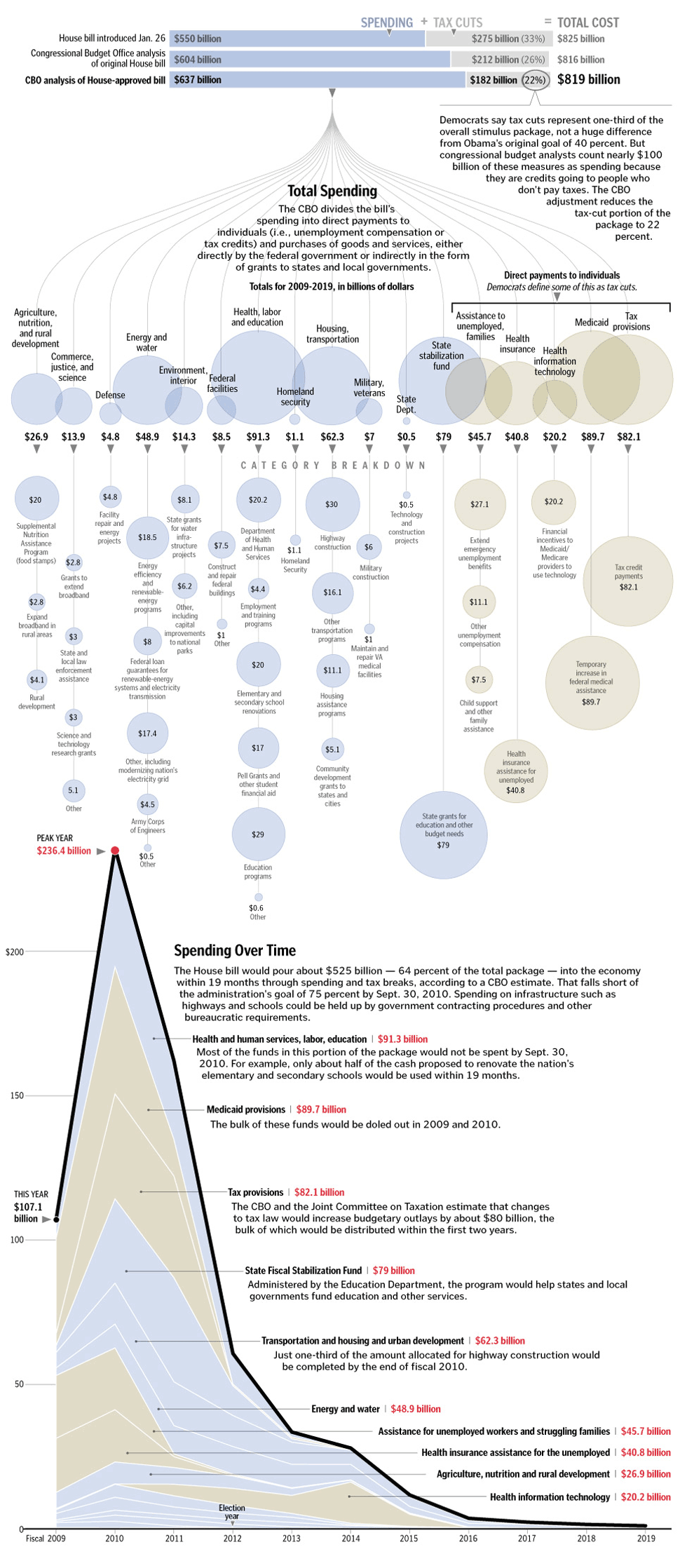
(A visual schematic of America’s stimulus dollars at work, as proposed under the recently approved House bill…)

Filed by The Editor on February 10th, 2009

February 6, 2009

flow of funds

Finance & Economics, Financial Crisis

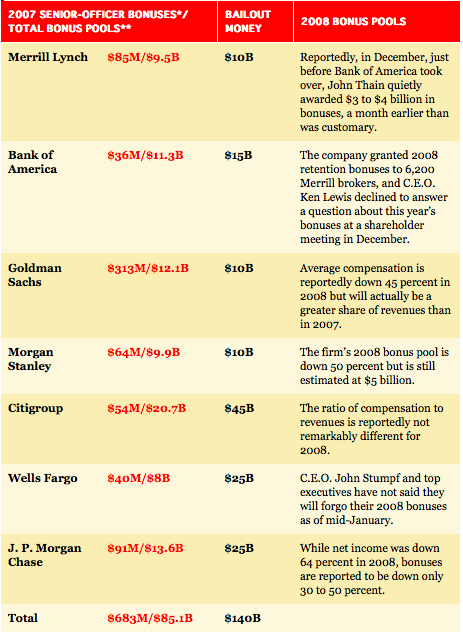
(The frightening this about this table isn’t lavish CEO pay after record bank losses, nor the 9-figure scale of the payouts, but just how closely the bailout money matches the total bonus pool in almost every case. Granted, base compensation in investment banking is nearly equivalent to the minimum wage, but there are a lot of people – roughly 3.6 million in America alone – that would jump at the chance to make $150,000 for 90 hour work-weeks, if only they could…)

picture-3
SOURCE: The Big Picture

*Total of top five bonus packages (including stocks) received by highest-ranking officers.**Estimated as 60 percent of compensation where exact figures are not available.

Filed by The Editor on February 6th, 2009

February 1, 2009

synchronicity

Finance & Economics, Financial Crisis, History & Society, In Other Words

(This TED talk by mathematician Steven Strogatz “shows how flocks of creatures (like birds, fireflies and fish) manage to synchronize and act as a unit — when no one’s giving orders”. The parallels to market behavior and financial panic are implicit but obvious. We often perceive of our decisions during a crisis as unique and self-preservational, but the tendency toward spontaneous order is a powerful impulse. The coordinated reaction to natural threats, be it a hungry seal or predator hawk, can often increase a group’s biological fitness and probility of survival, while a coordinated reaction to synthetic financial crises can actually amplify individual exposure – like Strogatz’s example of London’s Millenium Bridge – and actually make matters worse…)

Filed by The Editor on February 1st, 2009

January 25, 2009

the great experiment

Finance & Economics, Financial Crisis, In Other Words

(For nearly a quarter century, Milton Friedman’s monetarists and their acolytes at the Federal Reserve have pursued American prosperity on the assumption that the sheer quantity of money in the economy, along with the degree to which it turns over annually, are the principal levers shaping macroeconomic fundamentals. For the better part of the 20th century that assumption proved to be true as money supply was carefully managed, rising when the economy slowed down and contracting when it looked to be overheating.

The theory originally draws its roots from a flawed response by the Fed to the Great Depression, which might have been mitigated if only the Bank had started printing money, flooding inter-war markets with much needed capital to unfreeze bank lending and stimulate private demand for consumption and investment. Instead, the Fed evaporated what little capital was left by actually raising interest rates, thereby decreasing business investment and placing upward pressure on the dollar. This made the country’s exports less competitive and slowed industrial activity to a crawl, pushing unemployment at its height to nearly 25% – not including women who at the time represented only a small fraction of the paid workforce.

What follows is an examination of the monetarist school of thought as it has evolved over time, along with evidence of its recent failings and the limited options that now remain for its practitioners in dealing with the current financial crisis…)

THE GREAT EXPERIMENT

Quarterly Review and Outlook — Fourth Quarter 2008
Hoisington Investment Management Company

The late Nobel Laureate, Milton Friedman, noted in his 1963 book, Monetary History of the United States (coauthored with Anna Swartz), that the money stock decreased by a massive 31% in the Great Depression. The turnover of that money, called velocity, fell 21%. Nominal GDP equals money multiplied by velocity. Consequently, from 1929 to 1933 the breakdown of both measures resulted in a contraction in nominal GDP of approximately 50%. However, Friedman postulated that if the Fed had not let money shrink, velocity would have been steady and the Great Depression would have been averted, i.e., nominal GDP would not have collapsed. Our current Fed Chairman, Ben Bernanke, is an expert on the Great Depression, and he has, in fact, adopted Friedman’s strategy to greatly expand the money supply. Whether this prescription for economic stability will work in a period of over indebtedness, such as now exists in the U.S., is most uncertain. Indeed, this could be called the “great experiment” since this economic theory has yet to be thoroughly tested in the real world.

(more…)

Filed by The Editor on January 25th, 2009

January 22, 2009

black (scholes) hole

Finance & Economics, Financial Crisis, In Other Words

(Scientists and market commentators have long been aware of the susceptibility of the markets to any single investment philosophy. The rise of early program trading contributed to the historic one-day loss of nearly 23% on Black Monday in 1987, and later experiments with the seemingly innocuous yen-carry trade and more broadly the bundling of leverage into collateralized pools of assets have generated severe economic dislocations that have cost trillions of dollars to unwind and may take years to fully digest. In this piece by veteran commentator Michael Lewis, the blame is placed squarely on the flawed assumptions of the Black-Scholes model, and the degree to which its methodology spread from the arcane trading desks of the world’s biggest investment banks to the private retirement savings of the beleaguered middle class…)

Inside Wall Street’s Black Hole
by Michael Lewis

For years, investors have relied on a complex formula to manage risk. But what happens if the Black-Scholes model is wrong—and we’re in bigger trouble than ever?

The striking thing about the seemingly endless collapse of the subprime-mortgage market is how egalitarian it has been. It’s nearly impossible to draw a demographic line between the victims and the perps. Millions of ordinary people ignorant of high finance have lost billions of dollars, but so have the biggest names on Wall Street, and both groups made exactly the same bet: that real estate values would never fall. Stan O’Neal, the former C.E.O. of Merrill Lynch, was fired for the same reason the lower-middle-class family in the suburban wasteland between Los Angeles and San Diego may have lost its surprisingly nice home. Both underestimated the likelihood of an unlikely event: a financial panic. In retrospect, the small army of Wall Street traders who lost tens of billions of dollars in subprime-mortgage investments looks as naive and foolish as the man on the street. But there’s another way of viewing this crisis. The man on the street, for the first time, acted on the same foolish principles that have guided the behavior of sophisticated Wall Street traders for the past few decades.

(more…)

Filed by The Editor on January 22nd, 2009

January 15, 2009

underground economies

Finance & Economics, History & Society, In Other Words, The Middle East

(The existence of black markets in virtually every economy on the planet is a testament to human resourcefulness and natural entrepreneurship. For those that are building tunnels under Gaza’s border with Egypt, $100,000 and a few months work can generate up to $10,000 a day in fees, and help to provide critical supplies and less critical desires into the struggling Gaza strip. One economist has estimated that roughly 90% of the annexed economy is driven by these covert smuggling operations. Unfortunately, along with tea, cows, washing machines, and gas flow AK-47s, drugs, and anti-aircraft missiles as soaring Gazan demand meets profitable Egyptian supply…)

Photo Essay: Gaza’s (Literal) Underground Economy
By Preeti Aroon in November 2008

Since Hamas gained control of Gaza in June 2007, Israel has blockaded the flow of goods into and out of the territory. But when trade is closed aboveground, the economy simply moves underground, in more ways than one.

The land down under: Except for basic humanitarian supplies, Israel has blockaded the flow of goods into Gaza since June 2007, when Hamas, a militant Islamist group committed to Israel’s destruction, ousted its more secular rival, Fatah. The blockade has led to a new economic structure—a literal underground economy—in which everything from food to gasoline to underwear is illicitly imported from Egypt via underground tunnels into Rafah, which sits on Egypt’s border at the Sinai Peninsula. Above, Palestinian men pull a bag of smuggled food, milk, and other supplies from an underground tunnel linking Rafah, in southern Gaza, to Egypt, on June 27.

(more…)

Filed by The Editor on January 15th, 2009

January 10, 2009

size doesn’t matter

Finance & Economics, Financial Crisis, History & Society, In Other Words

(Assuming that our lot in life is simply a function of hard work, acquired skills, and a bit of good luck, the only real difference between liberals and conservatives is the degree to which we believe that those who fall on hard times – for whatever reason beyond their control – deserve a helping hand. The degree to which we publicly spend on that assistance is not only a question of socio-political philosophy, but also a matter of practical statecraft. Whether “leveling the playing field” or simply “setting the rules of the game”, pharohs, kings, and presidents have all made use of their regulatory oversight with varying degrees of success. This piece in the Boston Review by noted macroeconomist Dean Baker explores the limited imagination often used in the design of modern regulation, then asks us to consider not simply how much or how little the government ought to regulate, but more importantly how efficiently and effectively it can achieve a desired distribution of resources…)

Free Market Myth by Dean Baker
Regulation is everywhere. Let’s choose who benefits.

The extraordinary financial collapse of recent months has been commonly described as a testament to the failure of deregulation. The events are indeed testament to a failure—a failure of public policy. Blaming deregulation is misleading.

In general, political debates over regulation have been wrongly cast as disputes over the extent of regulation, with conservatives assumed to prefer less regulation, while liberals prefer more. In fact conservatives do not necessarily desire less regulation, nor do liberals necessarily desire more. Conservatives support regulatory structures that cause income to flow upward, while liberals support regulatory structures that promote equality. “Less” regulation does not imply greater inequality, nor is the reverse true.

Framing regulation debates in terms of more and less is not only inaccurate; it hugely biases the argument toward conservative positions by characterizing an extremely intrusive structure of, for example, patent and copyright rules, as the free market. In the realm of insurance and finance over the last two decades, calls for deregulation have been cover for rules tilted starkly toward corporate interests. And the recent change in bankruptcy law, hailed by conservatives, requires much greater government involvement in the economy.

False ideological claims have circumscribed the public debate over regulation and blinded us to the wide range of choices we can make. Without these claims, what would guide regulatory policy? What kinds of choices would we have?

(more…)

Filed by The Editor on January 10th, 2009

January 9, 2009

originative sin

Finance & Economics, Financial Crisis, History & Society, In Other Words

(The latest in a long series of articles on the Rational Post sharing a common refrain: those who forget economic history are condemned to repeat it…)

Originative sin: the future of banking
By John Plender at FT.com, January 4 2009

For the late John Kenneth Galbraith, an acute observer of market folly, finance and innovation were fundamentally incompatible. Every new financial instrument, he said, “is, without exception, a small variation on an established design, one that owes its distinctive character to the … brevity of financial memory”. The world of finance “hails the invention of the wheel over and over again, often in a slightly more unstable version”.

After the devastating collapse of a credit bubble that had seen explosive growth in new financial instruments, many politicians might feel Galbraith, if anything, understates the damage wrought by financial innovation.

So the post-bubble policy agenda is bound to address important questions. Is financial innovation a blessing or a curse? Given, at the very least, that it is double-edged, should innovation in finance be curbed, or kept far removed from the conventional commercial banking sector? And how possible is it anyway to control the inventiveness of banking’s rocket scientists on Wall Street and in London or the eagerness of their employers to make money from their ideas?

(more…)

Filed by The Editor on January 9th, 2009

January 8, 2009

the end of 20th century finance

Finance & Economics, Financial Crisis, History & Society

(A eulogy for 20th century finance by one of its greatest poets…)

The End of the Financial World as We Know It
By MICHAEL LEWIS and DAVID EINHORN

AMERICANS enter the New Year in a strange new role: financial lunatics. We’ve been viewed by the wider world with mistrust and suspicion on other matters, but on the subject of money even our harshest critics have been inclined to believe that we knew what we were doing. They watched our investment bankers and emulated them: for a long time now half the planet’s college graduates seemed to want nothing more out of life than a job on Wall Street.

This is one reason the collapse of our financial system has inspired not merely a national but a global crisis of confidence. Good God, the world seems to be saying, if they don’t know what they are doing with money, who does?

Incredibly, intelligent people the world over remain willing to lend us money and even listen to our advice; they appear not to have realized the full extent of our madness. We have at least a brief chance to cure ourselves. But first we need to ask: of what?

(more…)

Filed by The Editor on January 8th, 2009

January 5, 2009

conspiracy theory

Finance & Economics, History & Society, In Other Words

(For those still convinced that the Federal Reserve is the lynchpin in some grander economic conspiracy, this brief history of central banking in America should put some of your doubts to rest…)

Myth #1: The Federal Reserve Act of 1913 was crafted by Wall Street bankers and a few senators in a secret meeting.

On the Georgian resort hideaway of Jekyll Island (which has some excellent golf courses, by the way), there once met a coalition of Wall Street bankers and U.S. senators.  This secret 1910 meeting had a sinister purpose, the conspiracy theorists say.  The bankers wanted to establish a new central bank under the direct control of New York’s financial elite.  Such a plan would give the Wall Street bankers near total control of the financial system and allow them to manipulate it for their personal gain.G. Edward Griffin lays out this conspiratorial version of history in his book The Creature from Jekyll Island. His amateurish take on history is highly suspect, however.  Gerry Rough, in a series of well- researched essays on U.S. banking history, reveals many historical inaccuracies, inconsistencies, and even contradictions in Griffin’s book and others of its genre.  Instead of reproducing Rough’s work here, I offer the reader a substantially more accurate view of the events leading up to the creation of the Federal Reserve System in 1913.  To get a proper historical perspective, the story of begins just prior to the Civil War…

(more…)

Filed by The Editor on January 5th, 2009

January 4, 2009

china inc.

Finance & Economics, History & Society

(This counter-factual analysis of China’s path toward capitalism reveals that the country’s biggest cities aren’t necessarily the engines of dynamic Asian progress that modern commentators have suggested, and that the country’s future may lie in rural areas where entrepreneurship and competition have thrived since Deng Xiaoping’s Four Modernizations…)

Private ownership: The real source of China’s economic miracle
December 2008 • Yasheng Huang

The credibility of American-style capitalism was among the earliest victims of the global financial crisis. With Lehman Brothers barely in its grave, pundits the world over rushed to perform the last rites for US economic ideals, including limited government, minimal regulation, and the free-market allocation of credit. In contemplating alternatives to the fallen American model, some looked to China, where markets are tightly regulated and financial institutions controlled by the state. In the aftermath of Wall Street’s meltdown, fretted Francis Fukuyama in Newsweek, China’s brand of state-led capitalism is “looking more and more attractive.” Washington Post columnist David Ignatius hailed the global advent of a Confucian-inspired “new interventionism”; invoking Richard Nixon’s backhanded tribute to John Maynard Keynes, Ignatius declared, “We are all Chinese now.”

But before proclaiming the dawn of a new Chinese Century, leaders and executives around the world would do well to reconsider the origins of China’s dynamism. The received wisdom on the country’s economic miracle—it was a triumph of technocracy, in which the Communist Party engineered a gradual transition to the market by relying on state-controlled businesses—gets all the important details wrong. This standard account holds that entrepreneurship, private-property rights, financial liberalization, and political reform played only a small role. Yet my research, based on a detailed analysis of the Chinese government’s survey data and government documents at the central and local levels, indicates that property rights and private entrepreneurship provided the dominant stimulus for high growth and lower levels of poverty.

(more…)

Filed by The Editor on January 4th, 2009

Next Page »