articles tagged with: bubble
financial crisis, history & society, in other words »
A perennial hot ticket on the lecture circuit at economic clubs and grad schools around the planet, Paul Volcker’s influence is finally starting to resonate where it counts: at both ends of Pennsylvania Avenue. As his testimony in front of the Senate Banking Committee looms, the broader premise of a more responsible financial services sector pursuing sustainable, profitable growth needs to get out in clear journalistic prose from a messenger untarnished by the last 18 months of political and economic triage. This Sunday NYTimes op-ed attempts to do just that, despite the complexity of the topic. Unfortunately, it falls a little short for those either too stubborn or greedy to…
financial crisis, history & society, in other words »
“America’s mainstream religious denominations used to teach the faithful that they would be rewarded in the afterlife. But over the past generation, a different strain of Christian faith has proliferated—one that promises to make believers rich in the here and now. Known as the prosperity gospel, and claiming tens of millions of adherents, it fosters risk-taking and intense material optimism. It pumped air into the housing bubble. And one year into the worst downturn since the Depression, it’s still going strong.”
finance & economics, financial crisis, in other words »
Scientists and market commentators have long been aware of the susceptibility of the markets to any single investment philosophy. The rise of early program trading contributed to the historic one-day loss of nearly 23% on Black Monday in 1987. Recent experiments with risk securitization may cost trillions of borrowed dollars to unwind and decades to fully digest.
financial crisis, history & society, in other words »
“Spectacular episodes in financial history” come about more often than we might expect, and certainly more often than we remember. Harvard economist John Kenneth Galbraith wrote a brilliant primer on financial speculation in the early 1990s, suggesting that our memory for financial disaster was far more limited than our intelligence might otherwise suggest:
financial crisis, in other words »
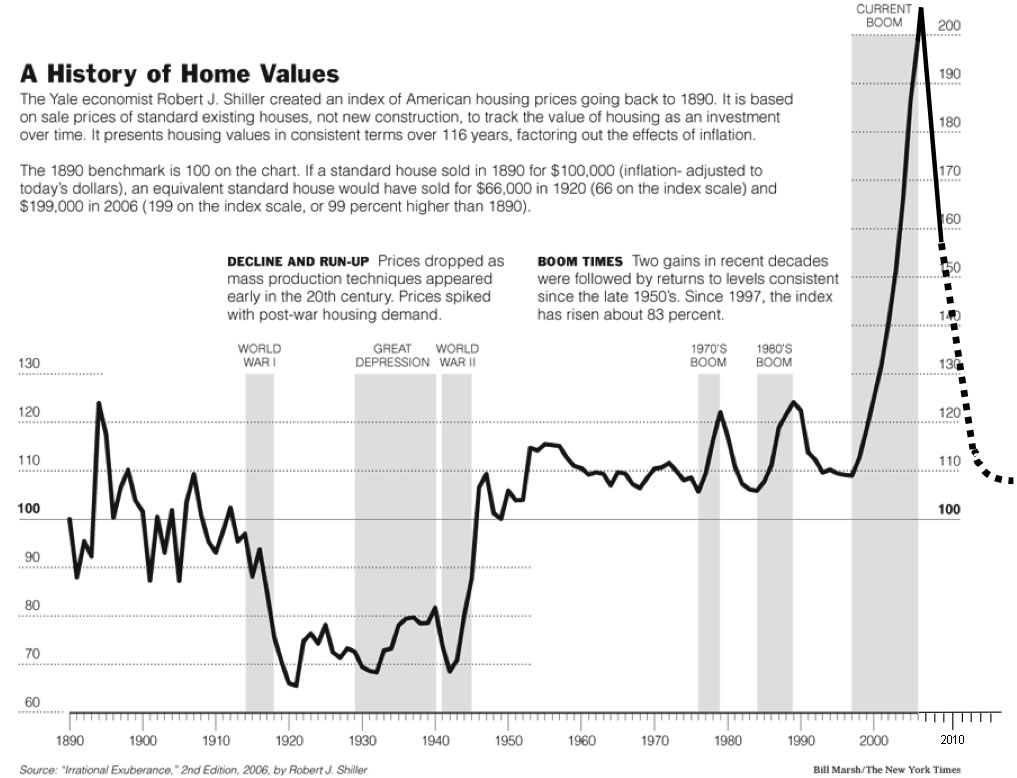
November 23, 2006—More dour news about the coming financial apocalypse, this time by noted economic strategist Dr. Gary Shilling. The augur, once again, is a hyper-inflated housing market, driven principally by excessive leverage, scandalous consumer spending, and inexhaustible financial optimism. “And why not?” you might ask. Everyone and their uncle has made money in real estate over the past five years, from the slummiest crack house to the most decadent penthouse. The more money everyone has, the more money everyone spends, and most developed economies have profited handsomely from that arrangement.
To get a sense of why the experts are now tempering such myopic enthusiasm, and why these so-called “speculative episodes” are inherently not in the economy’s best…
financial crisis, in other words »
Morgan Stanley’s chief global economist adds his voice to the growing choir of doomsayers, predicting heartbreak for employees and consumers throughout the high-cost, developed world. His thesis is simple: growth in the world economy has come not from soaring wages but from bubbalicious home prices, soaring corporate profits, American consumerism and low-cost third-world labour. As jobs continue to stream offshore and the markets pray for a “soft landing”, recession may be the only tune this chorus is willing to sing…
financial crisis, in other words »
“I can calculate the movement of the stars, but NOT the madness of men.”
- Sir Isaac Newton, after losing a fortune (£20,000) in the South Sea bubble.
I’ve been meaning to write about the impending real estate crash for quite some time, but until I get around to it, this piece is worth a read. Roubini is a Professor of Economics at the Stern School of Business at New York University, and the work below is taken from his blog. Though the prose is somewhat awkward, anyone who produces “seminal work in international macroeconomics, global macro policies, financial crises in emerging markets and their resolution, and the reform of…