finance & economics
finance & economics, financial crisis, in other words »
With all eyes on traditional residential mortgages, analysts are now looking for clues in related asset classes for any signs of recessionary contagion. In his weekly review of the U.S. economy, Nouriel Roubini highlights the vulnerability of commercial mortgage back securities – which typically lag their residential cousins by 2 years – as well as plunging retail sales, a worsening inventory cycle, and the soaring fiscal deficit…
featured, finance & economics, financial crisis, in other words »
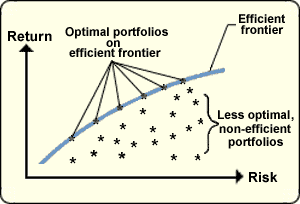
Faith in the underlying mechanics of portfolio theory and market efficiency has certainly contributed to humanity’s recent leap forward in wealth, productivity, private innovation, and global integration. But that same numerology has since crippled our aging financial system and triggered the worst global recession in nearly a century. Perhaps it’s time to reassess the value – and the logic – of bleeding edge finance.
As Professor Janeway points out in the following interview, treating securities like molecules, subject to the same variable distributions, “random walks”, differential equations, and reductionist math simply compounds the short-sighted actions of a few scientists-turned-gamblers. Not only does it greatly overstate the predictive power of econometric analysis, but it also understates the tremendous dangers of financial…
finance & economics, financial crisis, in other words »
Few people will escape from this crisis with enough reputability to scream “I told you so” at the top of their lungs like hedge fund neophyte Andrew Lahde. In this epilogue to his one year experiment in asset management – during which time his fund returned 866% betting on the subprime collapse – he rails on the industry, its myopic leadership, the vice of greed, and even the virtues of a little green plant…
finance & economics, financial crisis, in other words »
Words of cautious wisdom from the celebrated biographer of risk, back in November of 2007…
Crazy Little Thing Called Risk
By PETER L. BERNSTEIN
BACK when I was managing other people’s money, I had a client, a doctor, who enjoyed giving away money to his daughters. He was lucky, because an extended bull market was under way with only minor interruptions. The more he gave away, the more the market replaced what he had parted with. As generosity appeared to be a cost-free form of recreation, he considered the whole thing a riskless enterprise.
finance & economics, in other words, world affairs »
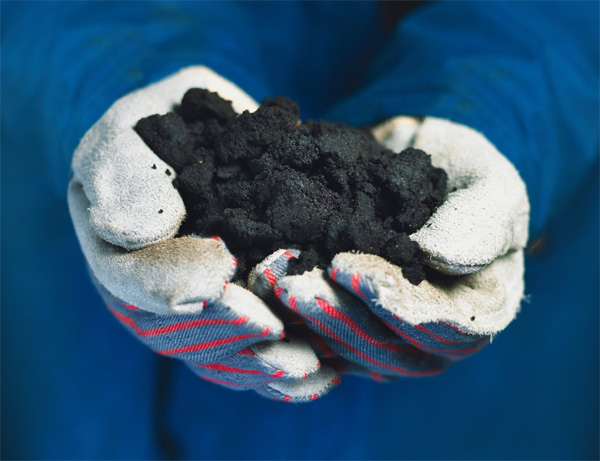
As Canadians flock to the polls later this month, quietly supplying 22% of America’s oil and 13% of its natural gas, its neighbours to the south have barely noticed. Cross-border oil flows are inevitable – given that America controls of a mere 2% of the world’s reserves and consumes almost 25% of supply – and securing its long-term petroleum assumes the full participation of Alberta’s carbon-rich tar sands and the off-shore bounty at Hibernia. Even Governor Palin’s Wildlife Reserve is virtually useless without passage by pipe across Canada’s Western provinces. Given the importance of “Securing America’s Energy Future” during a twin election year, it’s surprising that talk hasn’t returned to NAFTA,
finance & economics, financial crisis, in other words »
Even market cheerleaders are struggling to find good news to rally around these days. With labor, capital, finance, real estate, and consumer markets all reeling from a half-decade of credit-fueled gluttony, and commodities markets cresting near all-time highs, it might seem a bit clichéd to highlight yet another bearish commentator — unless that bear is David Rosenberg, one of the few bulge-bracket economists to voice frequent and convincing skepticism about the “resilience” of modern capital markets and highlight the irrational optimism of the average investor.
finance & economics, in other words »
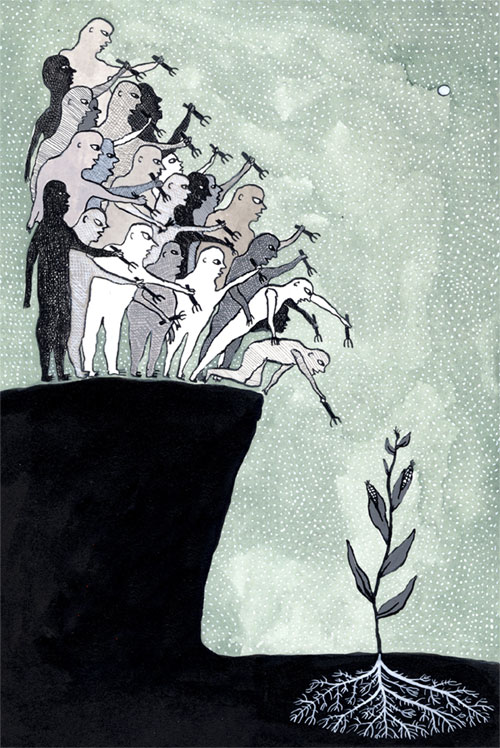
Further commentary on the interconnected themes of income disparity, agricultural inflation, and selective de-globalization, this time by Nobel Prize-winning economist Amartya Sen. Perhaps most compelling is the charge that a rising tide doesn’t lift all ships, and those who have benefited least from a “flattening” of our economic superstructure are often the most exposed to rising prices and shifting patterns of supply and demand. Also of note is the graphic artist chosen to visualize our scramble for scarce natural resources, yet another gifted Walrus alum…
finance & economics, financial crisis, in other words »
As financial institutions continue to navel gaze in the aftermath of the credit crisis, confidence in their ability to self-regulate continues to decline. With little trust in their assets, their markets, or even their peers, these global banking titans have sworn off their independence and, like disenchanted teens, are returning home to be cared for by risk-averse, populist policy-makers and their never-ending pool of taxpayers’ dough. The danger here is that both sides are still reacting to deeds already done, and nobody has yet proposed a solution to avoid similar financial chaos going forward. With threats to global income in the order of nearly a trillion dollars, whoever ultimately grabs this hot potato better have pretty thick skin…
finance & economics, financial crisis, in other words »
As markets continue to reel from the too-little-too-late conservative ethos that is snaking its way through the world’s major financial institutions, the wisdom of blind faith in some “invisible hand” is finally being put to the test. At stake are trillions of dollars of borrowed money floating anonymously within complex and unregulated markets, coupled with with an imploding US dollar, soaring energy demand in high-growth emerging economies, troublesome “business as usual” predictions for worldwide carbon emissions, and gross negligence in coordinating the world’s basic agricultural equilibrium. If free markets and “the wisdom of crowds” are truly the answer to the complex challenges of global resource coordination, recent evidence isn’t the least bit convincing…
finance & economics, history & society, in other words »
Social entrepreneurship is at the heart of Capitalism 2.0, and the country’s leading minds are finally demanding a full system upgrade…
Thoroughly Modern Do-Gooders
By DAVID BROOKS
Fashions in goodness change, just like fashions in anything else, and these days some of the very noblest people have assumed the manners of the business world — even though they don’t aim for profit. They call themselves social entrepreneurs, and you can find them in the neediest places on earth.
The people who fit into this category tend to have plenty of résumé bling. Bill Drayton, the godfather of this movement, went to Harvard, Yale, Oxford and McKinsey before founding Ashoka, a global change…
finance & economics, world affairs »
Assuming that the United States decides to impose a $25 per barrel tariff on all imported oil (crude and product) – and Canada and Mexico were not exempt — let’s explore how this might affect:
a. The volume of oil imported into the United States?
Volume responses to a $25 tariff would vary over time. In the near-term, there would only be a negligible decrease in the volume of oil imported (given a low short-run elasticity of energy demand) as industries, supply chains, and consumers remain highly dependent on existing petroleum infrastructure. The redistribution of the tariff (with tax reductions) would partially offset the incremental cost to businesses and consumers, but the policy is unlikely…
finance & economics, world affairs »
An excerpt from the mid-term “problem set” in ENR-302…
3. The country of Xanadu is dependent of the use of domestically produced methanol for 100% of its energy needs. The price of methanol is set by a competitive market and the fuel is priced at $2.50 per gallon. Two large companies supply 80% of the market and each has costs of $1.50 per gallon. The opposition party and most of the national labor unions argue that these two companies are making obscene profits. They demand that the President place a mandatory price cap of $2.00 on the price of methanol to prevent “this abuse of market power.”
Assume that the elasticity of demand is 0.4 and…
finance & economics, in other words, world affairs »
Another interesting analysis on the trade-off between economics and security. In this case, the existence of a low-cost, high-value, recreational good with addictive/inelastic demand has produced a covert, vertically integrated, structurally dynamic supply chain in northern Mexico. Stopping it would be akin to damming a river with a cheese cloth. Without a considerable increase in legal supply, a decrease in illegal demand, or ideally both, there’s little chance that the industry will dry up any time soon. More likely, as the author suggests, “The children and grandchildren of the Zetas will be running banks, running for president, building art museums and telling amusing anecdotes about how grandpa made his money running blow into Nuevo Laredo.” Sounds like the
An expanded look at the role corporations and hospitable business environments have played in stabilizing the anarchic system of international relations. This work is based on an earlier paper which focused on the rise of the corporation as a key variable in the calculus of global peace and security…
finance & economics, financial crisis, history & society, world affairs »
finance & economics, history & society, world affairs »
This paper was written for quite possibly the best combination of professor and class I’ve ever experienced. If only all academic endeavor challenged so profoundly, surveyed so broadly, and bore as much intellectual fruit…
Hegemonic Stability and the Rise of Global Corporations
by Devin DeCiantis
“The logic of markets is borderless,
but the logic of politics remains bounded.”
- Louis W. Pauley, Who Elected the Bankers? Surveillance and Control in the World Economy, 1997
finance & economics, in other words, world affairs »
Once the white gold of the natural resource world, catalyst of Caribbean war, and provider of luxurious European consumption, sugar still has its hold over American protectionist policy in some embarrassingly predictable ways…
finance & economics, in other words, world affairs »
With great power may come great responsibility, but middle power certainly has its role to play policing the economic and political bulge. In this address at the CFR, Canada’s Prime Minister waxes idealistically about the challenges of a national resource bounty that rivals any in the world, a mixed ethnic heritage that is the model for progressive integration, and a desire to project Canadian sovereignty and foreign policy into the 21st century…
finance & economics, financial crisis, in other words, world affairs »
With international markets still reeling from the “sub-prime meltdown” and investors already bracing for the next financial quake, it’s good to know that some of the world’s economic shepherds are well aware of the wolves on the horizon, however unprepared they might be to fight back. Unlike their more political and rhetorical peers, enlightened stewardship from the IMF and its sister organizations may be the global macro-economy’s only hope against the coming valuation storm, as risk quietly shifts from sophisticated financial institutions into the hands of the unsuspecting Everyman…
finance & economics, history & society, in other words, world affairs »
The Ford Foundation’s Values and Grant Letter
The Ford Foundation and the organizations that we support seek to:
reduce poverty and injustice,
promote democratic values,
increase international cooperation, and
advance human achievement.
finance & economics, history & society, in other words, science & tech »
As politicians and investors cast their enthusiastic support behind the legislation and technology necessary to christen the “New Age of Ethanol”, consensus among the world’s leading scientists is still critical at best. From hungry Mexicans to enraged environmentalists to ruffled foreign dignitaries, the real cost of ethanol has become increasingly obvious to all but the most cynical energy hucksters. Fueled by agricultural protectionism and the pressing drive for “energy independence”, the Ethanol Lobby is now humming on all cylinders, and if Runge and Senauer are right, that might spell disaster far beyond the pumps…