Navigation | Category » The Middle East
January 15, 2009
Finance & Economics, History & Society, In Other Words, The Middle East
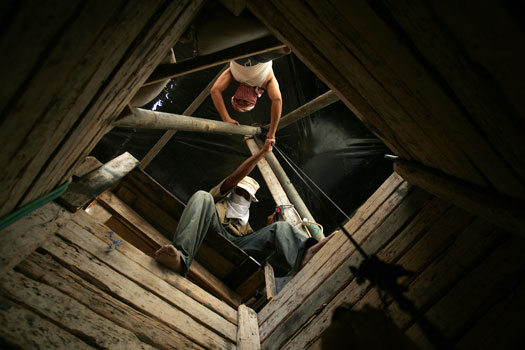
(The existence of black markets in virtually every economy on the planet is a testament to human resourcefulness and natural entrepreneurship. For those that are building tunnels under Gaza’s border with Egypt, $100,000 and a few months work can generate up to $10,000 a day in fees, and help to provide critical supplies and less critical desires into the struggling Gaza strip. One economist has estimated that roughly 90% of the annexed economy is driven by these covert smuggling operations. Unfortunately, along with tea, cows, washing machines, and gas flow AK-47s, drugs, and anti-aircraft missiles as soaring Gazan demand meets profitable Egyptian supply…)
Photo Essay: Gaza’s (Literal) Underground Economy
By Preeti Aroon in November 2008
Since Hamas gained control of Gaza in June 2007, Israel has blockaded the flow of goods into and out of the territory. But when trade is closed aboveground, the economy simply moves underground, in more ways than one.

The land down under: Except for basic humanitarian supplies, Israel has blockaded the flow of goods into Gaza since June 2007, when Hamas, a militant Islamist group committed to Israel’s destruction, ousted its more secular rival, Fatah. The blockade has led to a new economic structure—a literal underground economy—in which everything from food to gasoline to underwear is illicitly imported from Egypt via underground tunnels into Rafah, which sits on Egypt’s border at the Sinai Peninsula. Above, Palestinian men pull a bag of smuggled food, milk, and other supplies from an underground tunnel linking Rafah, in southern Gaza, to Egypt, on June 27.
(more…)
Filed by The Editor on January 15th, 2009
January 5, 2009
In Other Words, The Middle East
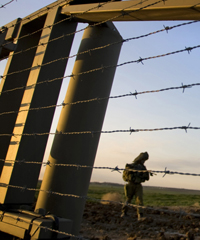
(If there’s any doubt remaining among global power-brokers that short-term foreign policy objectives are fundamentally flawed, recent events in the Levant have provided ample evidence. Such tribal conflict has played out in the Garden of Eden since northern Neanderthals and southern proto-human colonies first crossed paths during the last major Ice Age. Since that time, control over the region has changed hands a number of times, from Semetic tribes to Egyptian pharaohs to Roman Catholics to Muslim traders to Christian crusaders to Muslim Turks, and so forth. For every fence that was built and every line that was drawn, rivals always built a bigger ladder or dug a deeper tunnel. And so the feud was passed from generation to generation, weaving itself into the very fabric of the region’s fraternal cultures.
As war in the Promised Land erupts yet again, one can only hope that a definitive 21st century loss on all sides will be enough to drive the hard-liners from each camp toward a soft power compromise. But as history suggests, persistent tribal war simply galvanizes the next generation of fundamentalists. That’s precisely why a lasting peace has never materialized in a land where history is counted not in centuries but in millennia, and success not in compromise but in the other clan’s blood…)
Beyond Gaza
January 5, 2009 by Michael Moraz
Israeli infantry soldiers enter the Gaza Strip on January 4. (AP/Sebastian Scheiner)
Israel’s attacks into the Hamas-led Gaza Strip press into their second week with Israeli troops in possession of the northeastern reaches of the territory and diplomacy, to date, making very little impression. Early French efforts to head off a ground invasion failed, though President Nicolas Sarkozy appears determined to keep trying (CSMonitor). UN Security Council deliberations, tempered by knowledge that Washington will veto anything too critical of Israel, have led to stalemate (NYT). Egypt, a target of wrath from around the Arab world for maintaining its tight grip on the southern Gaza border crossing at Rafah (LAT), may have most at stake, and continues to press for a truce that would allow humanitarian aid into the battered enclave and possibly offer a foundation for wider talks. But Israel, so far, has proven unreceptive. Driving home Israel’s intention to continue with military operations, Foreign Minister Tzipi Livni rejected a Russian mediation offer (Haaretz), telling Moscow “we have no intention to … legitimize them and pass messages on to them.”
(more…)
Filed by The Editor on January 5th, 2009
November 16, 2007
History & Society, In Other Words, Politics & World Affairs, The Middle East
(After an inhospitable welcome at Columbia University and a defense of Iranian intentions in the halls of the UN, it was up to Charlie Rose to coax a straight answer from the puzzling Persian President and his schizophrenic vacillations between coherence and crusade. Neither Rose nor Ahmadinejad disappoint…)
Filed by The Editor on November 16th, 2007
November 9, 2006
History & Society, In Other Words, The Middle East
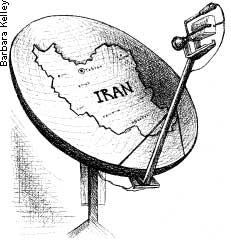
(This piece in the OpEd section of the Wall Street Journal could be written about any despotic regime in the history of humankind…except, of course, for the satellite dishes. Regime change rarely trickles from the top down, and when it does, it’s more like regime swap than any true social progression. In the case of Iran, a country with 70 million people — the majority of whom are under the age of 30 and two degrees removed from the last major revolution — the status quo isn’t all that bad. Those in the best position to pressure the powers that be are still too caught up in their sumptuous Middle Eastern lifestyle to vocalize any meaningful dissent, and that’s as true today as it was 1400 years ago when the secular Zoroastrian aristocracy took their first half-hearted bow toward the west…)
Iranian Moolah
How can you have a revolution when everyone is watching TV?
BY FAROUZ FARZAMI
TEHRAN–Killing time the other day on my way to meet my boyfriend, I walked through the long narrow passages of the House of Artists in the vicinity of the old U.S. Embassy, when I came upon a graceful exhibit of books published in America.
The books had been imported by a company called Vizhe Nasher (”special publication”), which is authorized, as it must be, by the government. Most concerned the visual and architectural arts, photography, sewing and cooking, and there was a wide variety offering weight-loss techniques, but I came across one I was startled to find: “The Daily Cocktail: 365 Intoxicating Drinks,” by Dalyn A. Miller and Larry Bonovan.
I live in a country where alcohol is officially banned, but where the art of homemade spirits has reached new heights. Sharing my astonishment about the cocktail book with some friends with better connections to the Islamist regime, they explained the government has a silent pact with the educated and affluent in Iran’s big cities, who render politics unto Caesar, provided that Caesar keeps his nose out of their liquor cabinets.
In other words, the well-to-do Iranian drinks and reads and watches what he wishes. He does as he pleases behind the walls of his private mansions and villas. In return for his private comforts, the affluent Iranian is happy to sacrifice freedom of speech, most of his civil rights, and his freedom of association. The upper-middle class has been bought off by this pact, which makes a virtue of hypocrisy.
(more…)
Filed by The Editor on November 9th, 2006
August 27, 2006
In Other Words, Language & Literature, The Middle East
(Few have understood the Middle East and it’s people like Lebanese-born poet and scholar, Khalil Gibran. In this, my favourite of his smaller works, Gibran explores the concept of cultural integration and social identity, relevant now more than ever in the land he once called home)
Chapter One: How I Became a Madman
You ask me how I became a madman. It happened thus: One day, long before many gods were born, I woke from a deep sleep and found all my masks were stolen — the seven masks I have fashioned and worn in seven lives — I ran maskless through the crowded streets shouting, “Thieves, thieves, the cursed thieves.”
Men and women laughed at me and some ran to their houses in fear of me. And when I reached the market place, a youth standing on a house-top cried, “He is a madman.” I looked up to behold him and the sun kissed my own naked face for the first time. My soul was inflamed with love for the sun, and I wanted my masks no more. And as if in a trance I cried, “Blessed, blessed are the thieves who stole my masks.”
Thus I became a madman. And I have found both freedom and safety in my madness; the freedom of loneliness and the safety from being understood, for those who understand us enslave something in us.
But let me not be too proud of my safety. Even a Thief in a jail is safe from another thief.
Chapter Two…
Filed by The Editor on August 27th, 2006
August 12, 2006
In Other Words, Politics & World Affairs, The Middle East
(With ink still drying on the UN Security Council’s draft resolution, Nusrullah has finally agreed to a cessation of hostilities, but insists that the fight will continue as long as Israeli troops are still on the ground. This, at a time when Israel itself has just voted to triple the size of its current military operation and continues to airlift troops into Southern Lebanon. Only time will tell if this latest in a long series of diplomatic efforts will succeed where the others have so catastrophically failed…)
UNSC DRAFT RESOLUTION LEBANON 1701
The Security Council,
PP1. Recalling all its previous resolutions on Lebanon, in particular resolutions 425 (1978), 426 (1978), 520 (1982), 1559 (2004), 1655 (2006) 1680 (2006) and 1697 (2006), as well as the statements of its President on the situation in Lebanon, in particular the statements of 18 June 2000 (S/PRST/2000/21), of 19 October 2004 (S/PRST/2004/36), of 4 May 2005 (S/PRST/2005/17) of 23 January 2006 (S/PRST/2006/3) and of 30 July 2006 (S/PRST/2006/35).
PP2. Expressing its utmost concern at the continuing escalation of hostilities in Lebanon and in Israel since Hizbollah’s attack on Israel on 12 July 2006, which has already caused hundreds of deaths and injuries on both sides, extensive damage to civilian infrastructure and hundreds of thousands of internally displaced persons.
PP3. Emphasizing the need for an end of violence, but at the same time emphasizing the need to address urgently the causes that have given rise to the current crisis, including by the unconditional release of the abducted Israeli soldiers.
PP4: Mindful of the sensitivity of the issue of prisoners and encouraging the efforts aimed at urgently settling the issue of the Lebanese prisoners detained in Israel.
PP5. Welcoming the efforts of the Lebanese Prime Minister and the commitment of the government of Lebanon, in its seven-point plan, to extend its authority over its territory, through its own legitimate armed forces, such that there will be no weapons without the consent of the government of Lebanon and no authority other than that of the government of Lebanon, welcoming also its commitment to a UN force that is supplemented and enhanced in numbers, equipment, mandate and scope of operation, and bearing in mind its request in this plan for an immediate withdrawal of the Israeli forces from Southern Lebanon,
PP6. Determined to act for this withdrawal to happen at the earliest,
PP7. Taking due note of the proposals made in the seven-point plan regarding the Shebaa farms area,
PP8. Welcoming the unanimous decision by the government of Lebanon on 7 August 2006 to deploy a Lebanese armed force of 15,000 troops in South Lebanon as the Israeli army withdraws behind the Blue Line and to request the assistance of additional forces from UNIFIL as needed, to facilitate the entry of the Lebanese armed forces into the region and to restate its intention to strengthen the Lebanese armed forces with material as needed to enable it to perform its duties,
PP9. Aware of its responsibilities to help secure a permanent ceasefire and a long-term solution to the conflict,
PP10. Determining that the situation in Lebanon constitutes a threat to international peace and security,
OP1. Calls for a full cessation of hostilities based upon, in particular, the immediate cessation by Hizbollah of all attacks and the immediate cessation by Israel of all offensive military operations;
(more…)
Filed by The Editor on August 12th, 2006
August 10, 2006
In Other Words, Politics & World Affairs, The Middle East
(Often referred to as a ‘private CIA,’ Stratfor just released an update on their coverage of the escalating violence in Iraq, the threat of another Sunni-Shi’a Civil War, and the challenge of unbridled Iranian imperialsm. Definitely worth a read if you haven’t been following the not-so-mainstream news…)
Breakpoint: What went Wrong
By Dr. George Friedman
CEO, Security Consulting Intelligence Agency
On May 23, we published a Geopolitical Intelligence Report titled “Break Point.” In that article, we wrote: “It is now nearly Memorial Day. The violence in Iraq will surge, but by July 4 there either will be clear signs that the Sunnis are controlling the insurgency — or there won’t. If they are controlling the insurgency, the United States will begin withdrawing troops in earnest. If they are not controlling the insurgency, the United States will begin withdrawing troops in earnest. Regardless of whether the [political settlement] holds, the U.S. war in Iraq is going to end: U.S. troops either will not be needed, or will not be useful. Thus, we are at a break point — at least for the Americans.”
In our view, the fundamental question was whether the Sunnis would buy into the political process in Iraq. We expected a sign, and we got it in June, when Abu Musab al-Zarqawi was killed — in our view, through intelligence provided by the Sunni leadership. The same night al-Zarqawi was killed, the Iraqis announced the completion of the Cabinet: As part of a deal that finalized the three security positions (defense, interior and national security), the defense ministry went to a Sunni. The United States followed that move by announcing a drawdown of U.S. forces from Iraq, starting with two brigades. All that was needed was a similar signal of buy-in from the Shia — meaning they would place controls on the Shiite militias that were attacking Sunnis. The break point seemed very much to favor a political resolution in Iraq.
It never happened.
(more…)
Filed by The Editor on August 10th, 2006
August 4, 2006
In Other Words, Politics & World Affairs, The Middle East
(Below is a transcript of the Charlie Rose interview with Rami Khoury, Editor-at-Large of The Daily Star, a leading English-language newspaper in Beirut. In the Middle East it’s been difficult to find a convincing argument against continued Israeli engagment in a non-Arab tongue, but this exchange, filmed on July 19th, cuts as close to the heart of the conflict as I’ve seen from a Palestinian commentator.
Charlie then followed up yesterday with former Secretary of State Henry Kissinger, who summarized the situation in his typical, pragmatic prose, sucessfully bringing Iran and nuclear arms into the discussion and accepting America’s share of the blame for mishandling the meltdown from the start. I’ve yet to find a transcript of the interview, but here’s a link to the video)
*CHARLIE ROSE:* There’s been a lot of focus on people trying to get out of Lebanon, but there are also people who’re trying to return to their country. One of those is Rami Khouri, editor-at-large of the newspaper the “Daily Star.” He joins me now by phone from Amman, Jordan. Thank you for doing this.
*RAMI KHOURI:* My pleasure.
*CHARLIE ROSE:* I have two big questions. Number one, do you think the Israelis, if they continue these attacks will be successful in doing great damage if not destroying the capabilities of Hezbollah?
*RAMI KHOURI:* I am pretty certain that they will fail in doing that, and the reason I say that is because they’ve tried this three or four times with various groups in Lebanon and failed. Over the last 25 years, they did it with the Fatah guerillas in the late `60s, they did with the PLO in the `70s, they did it with Hezbollah five — 10 years ago. They occupied south Lebanon for almost 20 years. They had free fire zones. They had no-go zones, they had red lines, blue lines, green lines. Killing zones. Interdiction zones; international troops. They tried every possible trick in the book. They even funded an armed – a surrogate army in south Lebanon.
Every single thing they have tried, including long-term military occupation, has failed. And the reason it has failed is that you cannot provide a military solution to a political problem. And you cannot win with overwhelming military force against a determined guerrilla group fighting for its national sovereignty and its human dignity. This is a lesson that every major military power in the world has learned and the Americans learned it in Vietnam. The Russians in Afghanistan, the French in Algeria, the Americans are learning it again in Iraq. And the Israelis are obviously not learning it over and over and over in Palestine and Lebanon, so it will not succeed. There’s no question about that.
*CHARLIE ROSE:* Why do you think the Israelis have not learned the lesson you think they should have?
*RAMI KHOURI:* I think Israel fundamentally as a nation has never been able to come to grips with two central notions in its modern history. One is the idea of a viable legitimate Palestinian state, and the other is with the nature of Arab national identity, which also includes Lebanon itself. The Israelis have been so obsessed with the idea of their own security and certainly, you know, rightly so, given their modern and ancient history of being persecuted and subjected to pogroms and holocausts. But they have allowed their over-focus on their security to blind them to the fact that they can never have security if their neighbors don’t have it. And I think this has been an irrational strain in – in modern Zionism. And unfortunately, the irrationality seems to have expanded into the White House now as well.
*CHARLIE ROSE:* I`ll come to that in a moment. It seems – because Nick Burns is on our show tonight. It seems to me that the Israelis or I would assume the Israelis will argue that we were prepared to make a giant bargain at Camp David when, first, with Sadat and then later with Yasser Arafat and Ehud Barak. It didn’t happen. We were prepared to take – to retreat from and withdraw from Gaza; we were prepared to try to create boundaries by withdrawing. We had plans on the board for withdrawing from the West Bank.
But Palestinians could not control — this is not Hezbollah. Palestinians could not control the most extreme elements within their population who continued to assault us across their border.
(more…)
Filed by The Editor on August 4th, 2006
August 3, 2006
In Other Words, Politics & World Affairs, The Middle East
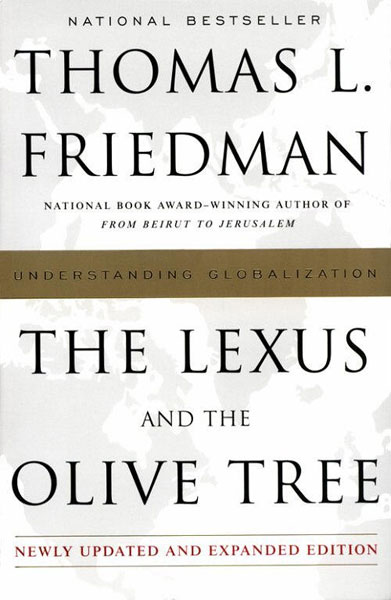
(an engaging fictional dialogue between former Secretary of State Warren Christopher and former Syrian President Hafaz el-Assad, from Thomas L. Friedman’s 2000 National Bestseller)
To illustrate this ever-present tension between today’s globalization system and the olive trees in us all, I once tried to imagine how a discussion would go if a very decent American Secretary of State, such as Warren Christopher, were to try to explain globalization to a not so decent leader, such as Syrian President Hafez el-Assad—a man of olive trees and the Cold War. It would sound like this:
Warren Christopher: “Hafez—you don’t mind if I call you Hafez? Hafez, you are yesterday’s man. You’re still living the Cold War. I know you’ve only traveled outside the Middle East a few times, so let me tell a little bit about the new world. Hafez, Syria debated for years whether to allow its people to have fax machines. Then you debated for five years whether to allow them all to have the Internet. That’s sad. That’s why your per capita income is only 1,200 dollars a year. And you can barely make a lightbulb. Since 1994, your entire private sector has barely exported 1 billion dollars a year. We have dozens of companies no one has ever heard of that export 1 billion dollars a year. Now, Hafez, the reason I’m telling you all this is because during the Cold War, it didn’t matter whether Syria made computer chips or potato chips, a Lexus or a lightbulb, because you could make a good living just by milking the superpowers for aid and blackmailing your neighbors.
Yes, I see you smiling, Hafez. You know it’s true. You milked the Saudis for billions by letting them know that there could be, as the Mafia would say, ‘an unfortunate accident’ in the Saudi oil fields if they didn’t pay up. You milked the Russians on Monday, Wednesday and Friday, the Europeans Tuesdays and Thursdays and the Chinese on Sunday. The Soviets even bought that junk your state-owned factories produced and gave you arms and aid in return for your friendship. It was a good living, Hafez, a good living, and you played them all off against each other brilliantly. Chapeau.
(more…)
Filed by The Editor on August 3rd, 2006
History & Society, In Other Words, The Middle East
(No history of any region is impartial and no telling of events ever objective, but this one from the folks at the Lebanese Political Journal sums up the country’s isolated Christian perspective and addresses many of the conflict’s recent political inflections)
Lebanon: A Primer
To understand the current conflict, one must understand the way Lebanese think about this situation.
I’ll note historical events alive in the minds of Lebanese, and note why Lebanese aren’t “infantile” (the preferred Israeli term at the moment) for blaming Syria and Iran. There are many other events that occurred in this time period, but these are the ones Lebanese focus on at the moment.
1976 – The Syrian Army enters Lebanon.
1978 – Israel invades south Lebanon.
1982 – Full scale Israeli invasion. Path of destruction carved up the coast. Constant shelling and fear. Then, the Sabra and Shatila massacre. During this time, Lebanese hated and feared the Palestinians, but they don’t figure into Lebanese fears at present.
(more…)
Filed by The Editor on August 3rd, 2006
August 2, 2006
In Other Words, Politics & World Affairs, The Middle East, Travel & Life
(An article on Slate.com from another American journalist with no desire to leave the greatest city in the Middle East. I’m with Faerlie…maybe it’s time to start buying up Lebanese real estate)
Staying On: Why I’m not evacuating Beirut.
By Faerlie Wilson
BEIRUT, Lebanon—From my balcony this afternoon, I watched as French, British, and American evacuees boarded chartered cruise ships in Beirut’s port about a half-mile west of my apartment.
And over the last few days, while bombs and artillery pummeled the southern part of the city, I made the decision not to leave Lebanon. Explosions rock my building even as I write this, but I’m staying put.
I’m not crazy, and I harbor no death wish. This is simply the rational decision of someone who has built a life in Lebanon, who believes in this place and its ability to bounce back. I choose to bet on Beirut.
After five visits to Lebanon over as many years, I moved to Beirut from California this February. I’m a 24-year-old American with friends but no family here. But Lebanese hospitality makes it easy to feel at home; it’s a warm society that exudes and embodies a sense of interpersonal responsibility. Live here for two weeks and then go out of town, and you’ll get a dozen offers to pick you up at the airport upon your return.
(more…)
Filed by The Editor on August 2nd, 2006
July 12, 2006
Politics & World Affairs, The Middle East, Travel & Life
(Thoughts from the frontlines of the war in Lebanon. What I know I’ve included, and what I don’t I’ll leave up to you. Internet has been tough to find but I’ll try to keep things updated as often as I can. For more background on the conflict, check out our ongoing coverage of the Middle East)
Wednesday, July 12, 2006 | 12:01PM
Twelve plus hours after we landed in Beirut, the only civilian airport in the country was bombed by the Israeli Air Force. Apparently Hezbollah commandos crossed the Green Line last night and kidnapped two young Israeli soldiers, just weeks after a soldier was held for ransom by Hamas guerillas in Gaza City. Israel retaliated swiftly by taking half of the Palestinian Authority hostage and pounding the capital with missiles. Here in Lebanon, people expect the IDF to follow a similar protocol: first blasting from above, then invading with armoured vehicles for the first time in over six years. Whispers have begun to circulate about a march all the way to Beirut.
The whole episode raises obvious questions about connections to broader Islamic militancy, in a region already terrorized by conspiracy and unbounded nationalism. Despite its many conflicts with Shi’ism over the centuries, Syria’s Sunni leadership stands accused by the international community of funding Hezbollah’s occupation in the south, along with wealthy Shi’a extremists in nearby Iran. Even today, decades after their initial political and military intervention, the Syrians hold considerable sway in Lebanese domestic and international affairs, locked in a perpetual arm-wrestle with Israel over control of the Fertile Crescent. The country was also fingered in the assassination last summer of former Lebanese president/billionaire reconstructionist, Rafik Hariri, and is still perceived by students of the region’s tumultuous history as anything but neutral.
Perhaps it is this same Damascus connection (with their sponsors in Tehran) that has generated nothing but silence from international power brokers. Perhaps it is the threat of bilateral nuclear war. With the region set to convulse, armed conflict now seems inevitable. Extremists in Gaza and elsewhere are slowly wiping out centuries of misguided Western diplomacy and replacing it with Iraqi-style chaos and a new axis of Arab power, free of Judeo-Christian influence and foreign resource control. To be fair, a sustained regional peace has eluded local tribes since the rise of ancient Jericho over 11,000 years ago, but without any enlightened negotiation or creative political compromise — and a really long history lesson for leaders on both sides — hostilities aren’t likely to vanish any time soon, and the conflict between Hezbollah and Israel will likely escalate into a broader regional war.
Such a wonderful backdrop for my cousin’s wedding. Glad I brought my nicest suit.
(more…)
Filed by The Editor on July 12th, 2006
June 23, 2006
In Other Words, Politics & World Affairs, The Middle East
(Few scholars have had such a profound impact on their field of study as Bernard Lewis, Professor Emeritus of Near Eastern Studies at Princeton University. In this recent Q&A, he addresses the untold roots of Arab rage, the complex challenges of expanding Western empires, the rise of the Islamic mullahcracy and the mystery of the Danish cartoons. Now into his 90s, the outspoken orientalist continues to search for the ultimate compromise, contrasting “a nation divided into religions” with “a religion divided into nations”. The transcript is a little bit lengthy but well worth the read…)
Islam and the West: A Conversation with Bernard Lewis
Thursday, April 27, 2006
Hay-Adams Hotel, Washington, DC
LUIS LUGO: We are delighted to have Professor Bernard Lewis with us today. Professor Lewis is one of the most influential scholars of Islam of our time. For more than 60 years, he has specialized in the history of Islam, particularly in the Middle East, and the relationship between Islam and the West, a relationship that has become arguably the single-most important U.S. foreign policy concern of the 21st century. It was Professor Lewis who coined the term “clash of civilizations,” three years before Samuel Huntington used that phrase in his famous article in Foreign Affairs, setting the stage for a vigorous debate about the relationship between Islam and the West.
I submit that if one is going to have a serious conversation on the topic of Islam and the West, any short list of invitees would surely include the name of Bernard Lewis. We are delighted to have him with us here today.
MR. LEWIS: Thank you, ladies and gentlemen. It is certainly a privilege and, I hope to discover, also a pleasure to be with you today. As time is short, I shall waste no further time on ceremonial formalities and get straight to the one or two points that I shall have time to make, and leave the rest for you to develop in the course of our subsequent discussion.
Let me begin with the name, which has been given — not by me — to our discussion today: the West and Islam, sometimes also Islam and the West, depending on your perspective. You will surely be struck by a certain asymmetry in this formulation. On the one side, a compass point; on the other, a religion. Now, of course, we use “the West” in a number of different senses, but primarily, they are political, strategic, cultural, even civilizational, but not normally religious. The one religious term I have heard used for the West is the post-Christian world. I needn’t develop the implications of that term. Islam, on the other hand, is the name of a religion. And it is a part of human society identified by itself, and therefore also by others; not the other way around, in terms of religion.
But having said that, I think one needs to be more specific. In talking of the Christian world, in English — and, I suppose, in all the other languages of the Christian world — we use two terms: Christianity and Christendom. Christianity means a religion, in the strict sense of that word, a system of belief and worship and some clerical or ecclesiastical organization to go with it. If we say Christendom, we mean the entire civilization that grew up under the aegis of that religion, but also contains many elements that are not part of that religion, many elements that are even hostile to that religion. Let me give one simple example. No one could seriously assert that Hitler and the Nazis came out of Christianity. No one could seriously dispute that they came out of Christendom.
In talking of Islam, we use the same word in both senses, and this gives rise to considerable confusion and misunderstanding.
(more…)
Filed by The Editor on June 23rd, 2006