articles tagged with: history
finance & economics, history & society, in other words, world affairs »
It isn’t surprising that so-called “ambulance economics” has gained mass policy appeal as the global economy descends into madness. The battlefield, after all, is no place for quiet research and careful study. But even the most pressing humanitarian disasters could use a little “clinical economics” to help decision-makers better chart out the way forward. Recent poverty relief efforts in Haiti, for instance, should certainly focus first on the bare essentials of sustenance, sanitation, and security. Once politicians and development professionals are able to stop the bleeding, however, the really critical work actually begins in terms of supporting the long-term prosperity of the country. In that spirit, any path forward should take into consideration the unique historical, geographic, cultural, and economic…
financial crisis, history & society, in other words »
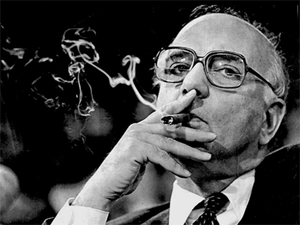
A perennial hot ticket on the lecture circuit at economic clubs and grad schools around the planet, Paul Volcker’s influence is finally starting to resonate where it counts: at both ends of Pennsylvania Avenue. As his testimony in front of the Senate Banking Committee looms, the broader premise of a more responsible financial services sector pursuing sustainable, profitable growth needs to get out in clear journalistic prose from a messenger untarnished by the last 18 months of political and economic triage. This Sunday NYTimes op-ed attempts to do just that, despite the complexity of the topic. Unfortunately, it falls a little short for those either too stubborn or greedy to listen or too impatient to digest his astute commentary on the benefits and challenges…
financial crisis, headline, history & society »
Much like the shifting partisan politics which rules Washington in 2- to 4-year cycles, stewardship of the Federal Reserve has ebbed and flowed between neo-Keynsians and Austrians since the birth of American central banking nearly 90 years ago. Two of the Fed’s greatest leaders and keenest minds have crafted American monetary policy for most of the last three decades, and yet they couldn’t be more different.
This is their story.

financial crisis, history & society, in other words »
Exploring the recent economic “upheaval” through the lens of history helps in at least two ways: 1) it assures us that humanity has faced similar dangers in the past and somehow lived to tell the tale, and 2) it suggests that the same entrepreneurial instincts that led us into trouble (yet again) also hold the key to restoring stability and growth. This speech by the President of the World Bank highlights a series of events that presaged the crisis — like the “emergence” of emerging economies, the popularity of leveraged finance, and growing imbalances of trade — focusing less on the outcome and more on the decades of unbridled expansion that inspired it…
financial crisis, history & society, in other words »
A comprehensive if somewhat subjective view of the two years since the credit crisis first broke, direct from the horse’s mouth. Perhaps more interesting than any insider account of the Fed’s frantic response to the meltdown of the banking system is the degree to which the Chairman was concerned with the human impact of his macroeconomic policy-making…
financial crisis, history & society, in other words »
While many observers are still consumed by the economic complexities of the financial crisis, historians have been busy making predictions about the ominous geopolitical implications of a destabilized global economy, rising unemployment, falling incomes, and swelling ethnic tensions. Much like its individual citizens, countries in the aggregate tend to retrench in the face of uncertainty about the future, and that could lead to some dangerously myopic decision-making in the months and years ahead…
financial crisis, history & society, in other words »
“The human mind cannot grasp the causes of phenomena in the aggregate. But the need to find these causes is inherent in man’s soul. And the human intellect, without investigating the multiplicity and complexity of the conditions of phenomena, any one of which taken separately may seem to be the cause, snatches at the first, the most intelligible approximation to a cause, and says: ‘This is the cause!’ ”
— Leo Tolstoy, War and Peace, Book IV, Part 2, Chapter 1, first paragraph
fiction & art, history & society, in other words, world affairs »
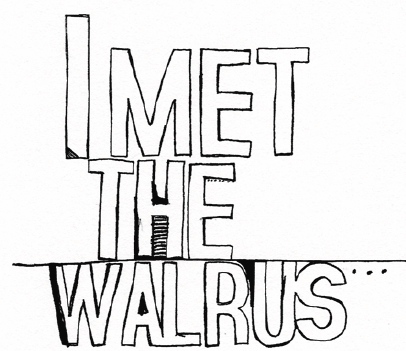
“In 1969, a 14-year-old Beatle fanatic named Jerry Levitan, armed with a reel-to-reel tape deck, snuck into John Lennon’s hotel room in Toronto and convinced John to do an interview about peace. 38 years later, Jerry has produced a film about it. Using the original interview recording as the soundtrack, director Josh Raskin has woven a visual narrative which tenderly romances Lennon’s every word in a cascading flood of multipronged animation. Raskin marries the terrifyingly genius pen work of James Braithwaite with masterful digital illustration by Alex Kurina, resulting in a spell-binding vessel for Lennon’s boundless wit, and timeless message...”
finance & economics, financial crisis, in other words »
For nearly a quarter century, Milton Friedman’s monetarists and their acolytes at the Federal Reserve have pursued American prosperity on the assumption that the sheer quantity of money in the economy, along with the degree to which it turns over annually, are the principal levers shaping macroeconomic fundamentals. For the better part of the 20th century that assumption held true as money supply was carefully managed, rising when the economy needed a boost and contracting when it was overheating.
The theory draws its roots from a colossal failure by the Federal Reserve during the Great Depression.
financial crisis, in other words »
finance & economics, financial crisis, history & society, in other words »
The latest in a long series of articles on the Rational Post sharing a common refrain: those who forget economic history are condemned to repeat it…
Originative sin: the future of banking
By John Plender at FT.com, January 4 2009
For the late John Kenneth Galbraith, an acute observer of market folly, finance and innovation were fundamentally incompatible. Every new financial instrument, he said, “is, without exception, a small variation on an established design, one that owes its distinctive character to the … brevity of financial memory”. The world of finance “hails the invention of the wheel over and over again, often in a slightly more unstable version”.
in other words, the middle east, world affairs »
If there’s any doubt remaining among global power-brokers that short-term foreign policy objectives are fundamentally flawed, recent events in the Levant have provided ample evidence. Such tribal conflict has played out in the Garden of Eden since northern Neanderthals and southern proto-human colonies first crossed paths during the last major Ice Age. Since that time, control over the region has changed hands a number of times, from Semetic tribes to Egyptian pharaohs to Roman Catholics to Muslim traders to Christian crusaders to Muslim Turks, and so forth. For every fence that was built and every line that was drawn, rivals always built a bigger ladder or dug a deeper tunnel. And so the feud was passed from generation to generation,…
finance & economics, history & society »
This counter-factual analysis of China’s path toward capitalism reveals that the country’s biggest cities aren’t necessarily the engines of dynamic Asian progress that modern commentators have suggested, and that the country’s future may lie in rural areas where entrepreneurship and competition have thrived since Deng Xiaoping’s Four Modernizations…
finance & economics, financial crisis, history & society, in other words »
This brief history of regal extortion draws some parallels to today’s “sinister” Federal Reserve, though the links are less tenuous than Dr. Hoye and others often suggest…
financial crisis, in other words »
Economist John Kenneth Galbraith once noted that the financial memory is limited to 20 or 30 years. Author Mark Twain once suggested that history might not repeat itself but certainly rhymes. Together, these two simple observations may help to explain why so many of our structural crises are simply echoes of previous human folly…
financial crisis, history & society, in other words »
Over-the-counter gambling on the markets has been around much longer than modern derivatives pundits would have you believe. The New York Times was warning against “casino capitalism” as early as 1905, when side bets on market movements were both commonplace and unregulated, and won the attention of an American government still swaggering after its victory over the mega-trust companies of the late 19th century. The following 60 Minutes segment discusses both the nature of CDS instruments and how they’ve become just as dangerous today as they were in the “bucket rooms” or gambling houses of the 1920s…
featured, financial crisis, history & society, in other words »
“Despite its severity, we believe that the slump in stock prices will prove an intermediate movement and not the precursor of a business depression…” This advice from the Harvard Economic Society on November 2, 1929 illustrates that unbridled optimism in the capital markets was just as dangerous 80 years ago as it is today. Modern financial crises aren’t simply failures of regulatory oversight or inherent structural weakness. They’re a combination of the cyclicality of human behavior, the dangers of unbridled leverage, increased speculation by unsophisticated investors, and our complete lack of financial memory beyond 20 or 30 years.
financial crisis, history & society, in other words, world affairs »
While the world comes to terms with yesterday’s historic call for change, Nouriel Roubini and his team have pulled together a laundry list of the many great challenges that lie ahead…
financial crisis, history & society, in other words »
“Spectacular episodes in financial history” come about more often than we might expect, and certainly more often than we remember. Harvard economist John Kenneth Galbraith wrote a brilliant primer on financial speculation in the early 1990s, suggesting that our memory for financial disaster was far more limited than our intelligence might otherwise suggest: