Navigation | Category » Science & Technology
February 5, 2007
Finance & Economics, Science & Technology
One of the last developed countries to modernize competition in the red hot mobile sector, Canadian regulators have finally bent to the will of their constituents and — as of March 14, 2007 — will force incumbent cellphone operators to allow customers to switch service providers without losing their existing number. While that might not seem like such a dramatic shift in domestic policy on its surface, the move has been years in the making, though surprisingly, the changes have come with surprisingly little industry fanfare.
Within the more vocal activist community, advocates of Wireless Number Porting (or WNP) insist that such libertarian legislation benefits consumers, operators, and regulators. Critics, however, are quick to point out the material cost of technology needed to facilitate the new program, and the “churn” — or subscriber erosion — that will inevitably take place among the reigning oligopolistic operators. They also cite numerous examples of failed campaigns to liberate phone numbers from the clutches of bandwidth-hungry carriers, and the billions of dollars that have already been invested in spreading coverage across the world’s second-largest land mass.
One benefit of our technological tardiness is that we now have the benefit of examining how other WNP programs have been rolled out around the globe, and how successful or disruptive they’ve been for the various mobile stakeholders. The cost, however, is that we’re still one of the least-saturated cellular markets in the developed world, though all that might begin to change as Canadian markets open up to competition — and subsequently — technological innovation.
(more…)
Filed by The Editor on February 5th, 2007
September 12, 2006
Finance & Economics, Financial Crisis, In Other Words, Science & Technology
(Economics is converging with everything these days, from the environment to the grocery store to the bedroom. This time, the playing field is none other than the human brain itself, and the results are less surprising than they are empirically fascinating. Contrary to conventional thinking, it turns out that people won’t always act in the own best interests, and that’s as true for investing and gambling as it is for adultery and employment…)
MIND GAMES
by JOHN CASSIDY in the New Yorker
What neuroeconomics tells us about money and the brain.
Like many people who have accumulated some savings, I invest in the stock market. Most of my retirement money is invested in mutual funds, but now and again I also buy individual stocks. My holdings include the oil company Royal Dutch Shell, the drug company GlaxoSmithKline, and the phone company British Telecommunication. I like to think that I picked these stocks because I can discern value where others can’t, but my record hardly backs this up. I invested in BT in 2001, shortly after the Nasdaq crashed, when the stock had already fallen substantially, only to watch it slide another fifty per cent. I should have sold out, but I held on, hoping for a rebound. Five years later, the stock is trading well below the price I paid for it, and I still own it. I sometimes wonder what goes on in my head when I make stupid investment decisions. A few weeks ago, I had a chance to find out, when I took part in an experiment at New York University’s Center for Brain Imaging, in a building off Washington Square Park. In the lobby, I met Peter Sokol-Hessner, a twenty-four-year-old graduate student, who escorted me to a control room full of computers. Sokol-Hessner is completing a doctorate in psychology, but he is currently working on a research project in the emerging field of neuroeconomics, which uses state-of-the-art imaging technology to explore the neural bases of economic decision-making.
Sokol-Hessner is particularly interested in “loss aversion,” which is what I was suffering from when I refused to sell my BT stock. During the past decade or so, economists have devised a series of experiments to demonstrate just how much we dislike losing money. If you present people with an even chance of winning a hundred and fifty dollars or losing a hundred dollars, most refuse the gamble, even though it is to their advantage to accept it: if you multiply the odds of winning—fifty per cent—times a hundred and fifty dollars, minus the odds of losing—also fifty per cent—times a hundred dollars, you end up with a gain of twenty-five dollars. If you accepted this bet ten times in a row, you could expect to gain two hundred and fifty dollars. But, when people are presented with it once, a prospective return of a hundred and fifty dollars isn’t enough to compensate them for a possible loss of a hundred dollars. In fact, most people won’t accept the gamble unless the winning stake is raised to two hundred dollars.
(more…)
Filed by The Editor on September 12th, 2006
September 6, 2006
Language & Literature, Science & Technology
(Reading is believing…)
I cdnuolt blveiee taht I cluod aulaclty uesdnatnrd waht I was rdgnieg. The phaonmneal pweor of the hmuan mnid Aoccdrnig to a rscheearch at Cmabrigde Uinervtisy, it deosn’t mttaer inwaht oredr the ltteers in a wrod are, the olny iprmoatnt tihng is taht the frist and lsat ltteer be in the rghit pclae. The rset can be a taotl mses and you can sitll raed it wouthit a porbelm. Tihs is bcuseae the huamn mnid deos not raed ervey lteter by istlef, but the wrod as a wlohe. Amzanig huh? yaeh and I awlyas thought slpeling was ipmorantt!
Filed by The Editor on September 6th, 2006
March 9, 2006
In Other Words, Science & Technology, Travel & Life
(How can you compare the human body to an athletic shoe? Or worse still, the internal combustion engine? Those libertarians over at the Cato Institute have been sniffing some serious salt. With cardiac surgery approaching $100,000 a pop in the hands of the private sector, I’d be willing to bet that a 25-week wait in publicly-funded Sweden sounds pretty damn good to a Mexican waiter in Queens, or a Persian schoolteacher in East L.A. Which raises the obvious question: who’s health in really under the public’s beneficent care? Is it the endlessly wealthy or the helplessly weak? The answer, it turns out, is neither — unless you’re a surgeon or a pharma rep…)
(more…)
Filed by The Editor on March 9th, 2006
February 5, 2006
Language & Literature, Science & Technology
“The time has come,” the Walrus said, “To talk of many things…”
- Lewis Carroll, The Walrus and The Carpenter, 1872
That Charles L. Dodgson was considered by many to be a serial pedophile had little to do with his celebrated creative legacy. After all, he was a distinguished Anglican clergyman, a pioneer in early photography, a gifted mathematician, and above all, a writer of great fictional prose. As he wandered through the English language over a hundred years ago, his literary and personal idiosyncrasies led him from subject to subject and metaphor to metaphor, spawning works that have continued to delight his readers ever since.
But perhaps his most enduring legacy comes from the lines of a little known poem called The Walrus and the Carpenter, whose insight into the world’s natural pecking order has inspired everything from a #1 Beatles hit to an indictment of organized religion to a strangely popular obsession with the oversized mustache. In each case, this magnificent Arctic creature is personified in ways that extend far above its place in the natural order of things, and as the walrus continues to work its way into the popular imagery of our time, it has achieved something that Dodgson, for all his efforts, never could: an escape from sexual disgrace.
(more…)
Filed by The Editor on February 5th, 2006
September 22, 2005
Science & Technology, Travel & Life
From: J Dyck
Sent: September 22, 2005 5:50 PM
To: d
Subject: RE: NOVA | The Elegant Universe | Watch the Program | PBS
i’m moving on up my brother! went to “scooter school” on saturday…which was largely about watching car crashes (did you know the west german government used LIVE people to test car crashes in the 70s…nothing like watching a blond haired, blue eyed german kid going 30mph into a tree…”dis exhibit iz closed!”). i have a road test scheduled for next month! if all goes well, methinks i may take a week off and scooter around the east coast to check out some MBA schools (don’t say it…i already feel dirty enough). speaking of travels…i’m also thinking of coming up to your neck of the woods to ring in the new year…you gonna be around?
aside from that…life in the nyc is a-ok. sheryl is having her birthday this weekend so there’s much planning afoot. and how’s your lady?
keep writing and keep hanging on…you’re not missing a damn thing at work!
From:d
Sent: September 22, 2005 5:15 PM
To: J Dyck
Subject: RE: NOVA | The Elegant Universe | Watch the Program | PBS
still hanging on. desperately. building a 750sqft deck kinda helps. [see attached pics]


what’s this about a scooter? what you talkin’ about, willis?!
so i’m looking to write for magazines at some point. gonna try to self-publish the articles in a book as well (through amazon, b&n…full hardcovers with all the bestseller trimmings) at the very least, it would be mighty sweet to give to my kids someday! (”daddy…why does your writing suck?”)
how’s life in the giant apple?
From: J Dyck
Sent: September 22, 2005 4:31 PM
To: d
Subject: RE: NOVA | The Elegant Universe | Watch the Program | PBS
sweeeeeeeeeet…this is some serious sh#t! god bless public broadcasting…except the cbc!
hey bud…did you rejoin the working world or are you still holding out?
—–Original Message—–From: d
Sent: Thursday, September 22, 2005 1:48 PM
To: d
Subject: NOVA | The Elegant Universe | Watch the Program | PBS
in case anyone’s interested…
http://www.pbs.org/wgbh/nova/elegant/program.html
Filed by The Editor on September 22nd, 2005
August 5, 2005
Fiction & Art, Science & Technology
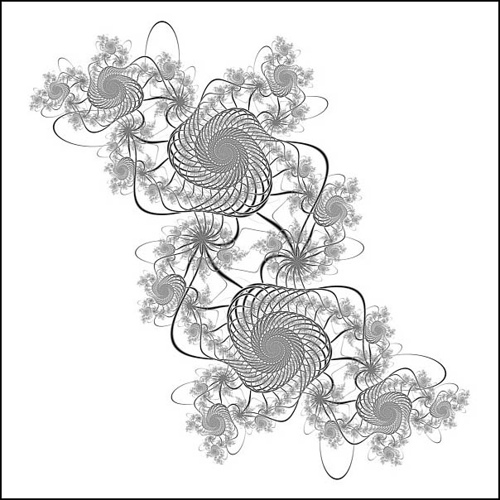
Math is truly a beautiful thing. It’s a simple and elegant truth that isn’t distracted by words or feelings, and at the same time, explains virtually everything we see and hear and feel. In some cases, it’s simplicity is downright brilliant, and in other cases, it’s brilliance is surprisingly simple. That’s not to suggest that math doesn’t have its inherent complexities — as well as some extremely unusual by-products — but deep at the heart of it all, there’s always some important underlying truth.
In the case of fractal geometry, that truth is inherently beautiful, both in its underlying mathematical functionality, and in its tremendous visual appeal. Every spiraling swirl you see in these stunning Julia Sets is a marvel of algebraic innovation. Loosely defined, the pictures represent “a set of points…for which nearby points do not exhibit similar behaviour under repeated iterations…” And yet, with all this dissimilar behaviour, the images produced seem anything but random at all. In fact, they seem distinctly organized.
As computers grew to prominence through the end of the last millennium, interested observers have finally been able to gawk at the brilliance of their complex algebra, and at the same time, marvel at the natural beauty it creates. So what exactly are these “fractals” anyway?
(more…)
Filed by The Editor on August 5th, 2005
July 18, 2005
Finance & Economics, Science & Technology
This absolutely blows my mind. With one simple download and a click of the mouse, I can literally zoom in from space on Moscow’s infamous Red Square, hovering less than 2,500 feet above St. Basil’s Cathedral and the ominous gaze of the Kremlin, as my computer pieces together terabytes of high-resolution satellite imagery from the urban landscape below.Then, with another subtle click, I’m flying back into space, and this time descend on one of the many sprawling banks of the raging Tigris River, closing in with crystal clarity on the now-empty walls of the National Museum of Iraq. Once home to some of the world’s greatest antiquities, the building is now just a depressing reminder of the often painful cost of Western “progress“.
Next, it’s off to Paris for a remarkably crisp view of Napoleon’s own tribute to war, the colossal Arc de Triomphe. Complete with tiny european cars and their larger ‘touring’ cousins, Google Earth gets you close enough to almost smell the billows of smoke from all those fancy french cigarettes, burning away smugly on the nearby Champs-Élysées.
Then, before I know it, I’m barrelling back down on Tian’anmen Square, like those fateful Communist Tanks on that fateful Socialist Day back in 1989. It’s only after casting my gaze over Beijing’s other great tourist attraction, the (relatively) peaceful Forbidden City, that I’m able to press on through this stunningly visual tour of the globe.
In rapid succession, I swoop over Christo Redentor in beautiful Rio de Janiero, followed by the Union Buildings in Pretoria, South Africa and the impressive Burj al Arab hotel in the new Vegas of the Middle East. But my last stop is perhaps the most disturbing of all. As the screen draws me down through the stratosphere and in toward the ground, my heart literally skips a beat.
There in front of me, plain as day, is the roof of my very own house. The very house I’m sitting in as I hammer away at this article. In fact, so detailed was the satellite image of my neighbourhood block that I could actually distinguish the colour of my shingles, and at closer inspection, easily recognized the large American sedan parked in front of my closest neighbour.
(more…)
Filed by The Editor on July 18th, 2005
June 27, 2005
Science & Technology
kissed my computer screen just now.
turns out i stumbled across (yet another) truly remarkable application of the internet this afternoon.
this time, it all started with a pair of musicians; and a pair of their greatest melodies. when combined, this fantastic foursome managed to distract me (quite easily) from what i was just about to do.
first, out of the cavernous depths of the world wide web, an untouchable brasilian sensation suddenly and irrepressibly emerged. inspired both by regional jazz legends as well as the all-time american greats, flora purim’s early and sensational rise to stardom began while singing over the inexhaustible ivories of keyboarding legend chick corea, and it eventually carried her into the upper strata of brasilian musical circles (a status she has yet to relinquish, even three decades later).
then, as if one great musician wasn’t enough, europe’s best known jazzmaster (django reinhardt) made his triumphant return to our very own rational radio and played the most fantastic, free-flowing guitar i’ve heard in a very long time.
it was both amazing, and completely unexpected.
so i turned, looked back longingly at my guitar, and smiled.
then i kissed my computer screen, and thought quietly to myself:
“the internet is a truly remarkable place…”
Filed by The Editor on June 27th, 2005
June 25, 2005
Fiction & Art, Science & Technology
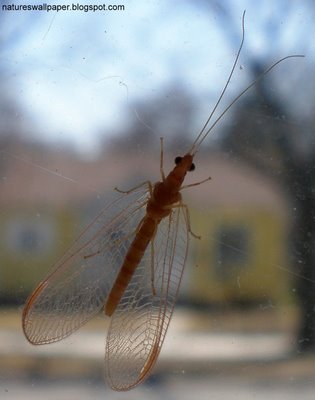
on tonight’s program, we marvel at the incredible life of the fishfly. that’s right…the fishfly.
fish-fly
A noun
1 fish_fly, fish-fly
similar to but smaller than the dobsonfly; larvae are used as
fishing bait
Category Tree:
entity
╚object; physical_object
╚living_thing; animate_thing
╚organism; being
╚animal; animate_being; beast; brute; creature; fauna
╚invertebrate
╚arthropod
╚insect
╚neuropteron; neuropteran; neuropterous_insect
╚fish_fly
while the internet has yet to embrace this particular woodland creature, if you’ll indulge me for the next few minutes, it would be my absolute pleasure to introduce you all to the reigning king of insect love.
first and perhaps most importantly, this heroic tale begins with a rather crippling disability. you see, the common fishfly is actually born without a mouth, and thus, has no physical way of ingesting any additional energy over the course of its brief but productive life. now given this cruel evolutionary twist of fate, what’s a poor fishfly to do?
in a tribute to modern darwinism, this crafty little insect eventually found a way to use what little life he was given to make the most of his genetic stock. “but how?” you might ask. “the damn thing can’t eat!”
what follows is a sample of the fishfly’s first few thoughts as it finally hatches from its deliciously slimey larvae and realizes the painful irony of its existence:
okay. no mouth. that really sucks.
plan b: gotta make babies. lots and lots of babies.
hmm. this could be fun…
(more…)
Filed by The Editor on June 25th, 2005
June 22, 2005
History & Society, Science & Technology
Imagine learning for the very first time that — contrary to public opinion and centuries of contemporary science — the world was actually round. Imagine being that first group of scientists (regents and spiritual leaders) or politicians (again, regents and spiritual leaders) or shell-shocked shepherds who grazed for thousands of years through the countrysides of the known world, convinced that if they wandered just a little too far, they might, in fact, fall right off the edge of the planet.
Life in those days was distinctly two-dimensional. There were the heavens, and there was the earth, and never the twain should meet. Stars were but holes in a giant celestial blanket while various pagan deities pulled the moon and the sun through the canvas of black and blue on the backs of celestial chariots.
At the time, “god” was the answer to all things unknowable. He was the lightning that punished the earth and the rain that nourished the soil; he was the sun that bathed the trees in light and the wind that whispered through their leaves; he was the exultant pleasure of conception and the unbearable pain of birth. He was the answer to every question and the question to every answer. And at the time, “god” saw that this was good.
This 2-D existence was popularized at the time by the early Mesopotamians, who thought of the world as a gigantic flattened disk, floating gently in the ethereal oceans of the universe. This essentially “linear” understanding endured for quite some time, as mathematics struggled to keep up with the incredible and growing “non-linear” physics of our world. It wasn’t until the golden age of ancient Greece that an alternative view of the universe finally emerged, and it took the collective wisdom of Pythagoras and Aristotle (among other prominent contemporary mathematicians) to prove with physical evidence — beyond a shadow of a doubt — that the earth wasn’t flat after all.
(more…)
Filed by The Editor on June 22nd, 2005
June 21, 2005
Language & Literature, Science & Technology
“How much?”
“A lot,” she replies.
“Generic answer” he says, as he heads down the stairs.
The guy has a natural fascination for numbers and quantity. He’s expecting an impressive response. But how much is a lot? And a lot more than what?
Just then, a book drops down on the table in front of her. To put this in context, a lot of books have dropped on the table in front of her these past few months. Well…maybe not dropped, but definitely placed with loving intention.
This time, it’s “A Brief History of Infinity: The Quest to Think the Unthinkable”.
So that’s what he meant. The biggest thing there is.
“Forget counting sheep,” he muses. “Staring at this for even a minute could knock me out on the spot.”
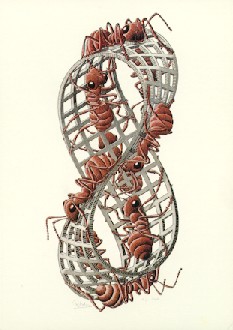
She looks at the image again, this time walking around its infinite edges with her beautiful brown eyes. It takes just a few revolutions around Escher’s inspiring geometric forms for her mind to begin to wander, first through the recesses of her own consciousness, and then out into the infinite worlds of physics, philosophy, theology and math.
Not surprisingly, this turned out to be a little more stimulating than counting four-legged pillows as they leap rather desperately over a rustic wooden fence. Imagine if restless children were told to “think big” instead of “count sheep” as they lay awake just before bed. Imagine the sort of dreams that might unfold if their tender creative minds were exposed to that sort of higer-order thinking, just as their growing little bodies slip peacefully under the captive veil of sleep.
“Alright, little Jamie. This time, I want you to try and think about how many grains of sand it would take to fill up the entire universe.”
“Alright, little Billy. This time, I want you to think about how you would walk along that never-ending line without falling off.”
Quite simply, it isn’t until you really concentrate on the infinite that your mind begins to wander in these amazingly novel ways. The Hitchhiker’s Guide (not surprisingly) contains the following useful illustration:
“Bigger than the biggest thing ever and then some, much bigger than that, in fact really amazingly immense, a totally stunning size, real ‘wow, thats big!’ time. Infinity is just so big that by comparison, bigness itself looks really titchy. Gigantic multiplied by colossal multiplied by staggeringly huge is the sort of concept we are trying to get across here…”
And so the children think, and sleep, and think some more. And the world is forever changed. Chasing the infinite is an exercise in cognitive futility, but in the end, that’s really the point. When you think about something so unbelievably massive, in contrast, everything else seems so remarkably insignificant. All of your other problems simply dissolve. They become trivial; mere droplets under the bridge.
“But he did this” and “she said that” become obsolete. Arguing over nonsense becomes pointless. Minds grow open to other perspectives, and in the inspiring spirit of Mill, any fundamental disagreements become invaluable stepping stones to an even greater understanding of the world around us (regardless of who was right and why).
And all this from a tiny little picture on the cover of a book, that still, in its infinite greatness, doesn’t quite describe the absolute enormity of her boyfriend’s original question.
“Infinity or not,” she insists. “Love is still the biggest thing there is.”
And for him, that answer was more than enough.
Filed by The Editor on June 21st, 2005
May 23, 2005
Science & Technology, Travel & Life
when was the last time you actually looked up? when was the last time you took a really, really good look at the sky? when was the last time you saw a full sunrise? when was the last time you saw a full moon? when was the last time you saw the rusty red sands of faraway mars?
the thing is, if you actually look up…i mean, if you actually stare up at the sky and see the planet mars with your own eyes, and ponder the significance of that observation, it puts things into a different sort of perspective. an almost galilean perspective. look up sometime and try to catch a glimpse at mars. not for the first time, of course…but for the first time as “mars, the planet“. not just as some tiny red speck in the sky, but as the only other (nearly) inhabitable world in our otherwise vacant solar system.
and for that matter, when was the last time you considered how long it took light from any of those stars to actually reach the backs of your eyes? when was the last time you actually peered back into the seemingly infinite history of the universe? before the earth had life (and in some cases, before the earth was even born). these are things we rarely consider when our eyes are confined to the more trivial meddlings of our own humble and relatively marginal existance here on earth.
so take a minute sometime…look up…and enjoy the grandeur of the universe. enjoy its enormity. enjoy our insignificance. then ask yourself whether it really matters that you didn’t get what you wanted at work today; that you didn’t score that winning goal; that the girl from the party never called you back; that the dice never rolled your way.
it always amazes me how life seems to change, almost instantly, when we put things back into their proper perspective. when we finally lift our eyes from the ground in front of us and start looking up. when we begin to see the world for what it is, and not what we always wanted it to be. when we take a good, long, rational look at our lives, and figure out exactly what we need to make things better.
worst case scenario?
the sky is still one unbelievable view.
Filed by The Editor on May 23rd, 2005