home » archive

financial crisis

financial crisis, history & society, in other words »

[22 Aug 2009 | Comments Off | ]
reflections on a year of crisis

A comprehensive if somewhat subjective view of the two years since the credit crisis first broke, direct from the horse’s mouth. Perhaps more interesting than any insider account of the Fed’s frantic response to the meltdown of the banking system is the degree to which the Chairman was concerned with the human impact of his macroeconomic policy-making…

finance & economics, financial crisis, in other words »

[9 Aug 2009 | Comments Off | ]
dead parrot of finance

As capital markets continue to increase in scale and scope, there is a natural tendency to believe that they have also become more accurate at valuation. Scores of “rational” investors acting in their own self-interest, based on their own proprietary information along with anything publicly available, make their best guess about the value of a particular security – from a simple common share of IBM to a bet on the amount of rainfall next April. Those who believe the future looks bright will buy, and those who think better days are behind will sell.

financial crisis, in other words »

[29 Jul 2009 | Comments Off | ]
ascending and descending

As speculative euphoria once again grips financial markets and investors emerge from their fallout shelters in search of higher yield, it is entirely possible that we failed to learn anything from the last 12-18 months of market volatility. After the markets bottomed out on March 9, our valuation anchors were rebased. Could our economic prospects really be that grim? Could all that leverage – all that cash – simply vanish from the financial system overnight? Of course not, went the refrain, and the markets have since pared back almost half of their 2008 losses during one of the largest bear market rallies since the 1930s.

financial crisis, history & society, in other words »

[15 Jul 2009 | Comments Off | ]
the man who crashed the world

Another entertaining piece of journalism by Michael Lewis, this time reporting from the nucleus of the financial crisis. The premise? Buried deep within the world’s largest insurance company lay the other side of the global bet on real estate and perpetual growth. Lewis interviewed the FP traders accused of underwriting the risky default swaps that nearly destroyed the world economy while siphoning-off juicy bonuses from the comfort of their gated Connecticut suburbs. What he turned up was a far bigger fish and an interesting chorus

finance & economics, financial crisis, in other words »

[4 Jul 2009 | Comments Off | ]
macrofinancial stability

Armchair financial quarterbacks would do well to tune out the mass media every so often and tune into the real global dialogue on the nature of the recent crisis and our prospects for a sustainable recovery. It is no coincidence that those whose perspective is truly global consider the fundamental nature of our modern political economy in terms of decades not days, systems not statistics, and welfare not wealth.
In this speech, given just weeks before the March 2008 arranged marriage of Bear Stearns and JPMorgan, this banker to central bankers dissects the credit crisis of 2007 and calls attention to dangerous fault-lines that presaged the apocalyptic deleveraging of the next 18 months…

finance & economics, financial crisis, in other words »

[12 Jun 2009 | Comments Off | ]
fuel tax

An interesting piece of analysis via TBP about rising gas prices crowding out retail and industrial consumption. The premise is sound but fails to acknowledge the already stimulative effect of a $2.50 decline in prices from their 2008 peak…

financial crisis, in other words »

[21 Apr 2009 | Comments Off | ]
eternal sunshine of the spotless balance sheet

Noted financial blogger Barry Ritholtz comments on macroeconomic housekeeping, the unexplored links between shrinking demand and credit-starved supply, and support for commodities and commodity-linked markets/currencies once institutional capital resumes its existential search for yield…

featured, financial crisis, history & society »

[27 Mar 2009 | Comments Off | ]
politico economicus

In the midst of a global financial pandemic, private enterprise finds itself under the public microscope yet again — as it did during the 1930s after a century of unbridled growth and later in the 1970s after decades of stifling regulatory oversight. With this 21st century changing of the guard, the theoretical bases for free market capitalism are now under academic and legislative review. At the heart of the debate is the accuracy of the economic models taught to college students around the planet as though they were immutable physical laws.

financial crisis, history & society, in other words »

[23 Mar 2009 | Comments Off | ]
axis of upheaval

While many observers are still consumed by the economic complexities of the financial crisis, historians have been busy making predictions about the ominous geopolitical implications of a destabilized global economy, rising unemployment, falling incomes, and swelling ethnic tensions. Much like its individual citizens, countries in the aggregate tend to retrench in the face of uncertainty about the future, and that could lead to some dangerously myopic decision-making in the months and years ahead…

financial crisis, history & society, in other words »

[19 Mar 2009 | Comments Off | ]
multiplicity and complexity

“The human mind cannot grasp the causes of phenomena in the aggregate. But the need to find these causes is inherent in man’s soul. And the human intellect, without investigating the multiplicity and complexity of the conditions of phenomena, any one of which taken separately may seem to be the cause, snatches at the first, the most intelligible approximation to a cause, and says: ‘This is the cause!’ ”
— Leo Tolstoy, War and Peace, Book IV, Part 2, Chapter 1, first paragraph

financial crisis, in other words »

[16 Mar 2009 | Comments Off | ]
syntax error

Contagion could be used to describe much of the activity in the capital markets over the last 40 years, as global financial flows have accelerated, trade and capital barriers have disappeared, regulatory oversight has diminished, and financial innovation has made the packaging and sale of securities as easy as ordering a Big Mac combo. From defaults on recycled petrodollars in the early 1980s, to the Mexican peso crisis in 1994, to the “Asian Contagion” in 1997-98, and most recently the Great Collapse of 2008, what began as sanity checks on asset values and risk metrics quickly evolved into stampedes of herding capital feeling to higher ground.

financial crisis, in other words, world affairs »

[13 Feb 2009 | Comments Off | ]
strong arm of the lawmakers

Few economists now doubt that private household spending and corporate investment will rescue the economy on their own. The debate now lies in the scale and scope of the government’s intervention, as the only institution with the access to capital, macroeconomic scope, and investment horizon needed to jump-start the labor market, keep production cycles from seizing up, and create the necessary conditions for manageable lending and spending to resume.

finance & economics, financial crisis, in other words »

[10 Feb 2009 | Comments Off | ]
stimulus maximus

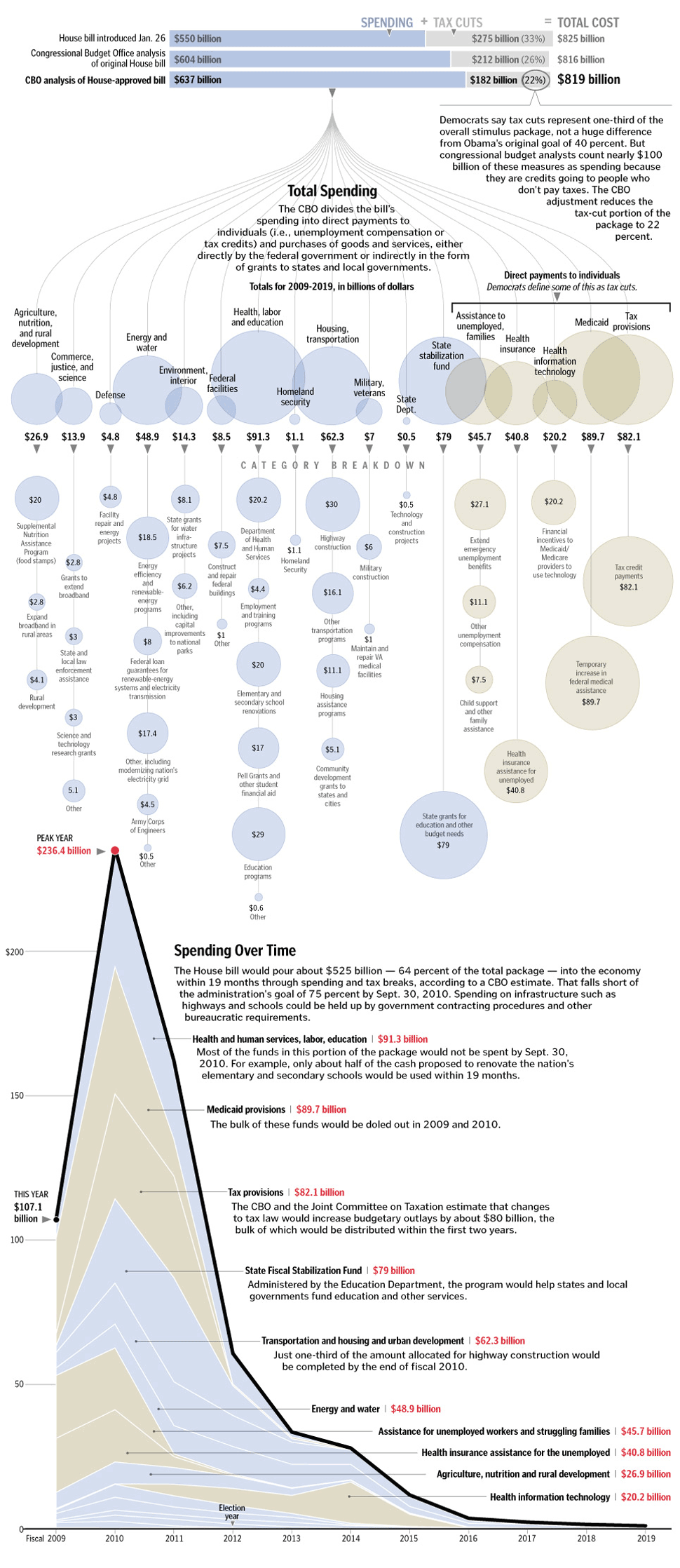
A visual schematic of America’s stimulus dollars at work, as proposed under the recently approved House bill…

finance & economics, financial crisis »

[6 Feb 2009 | Comments Off | ]
flow of funds

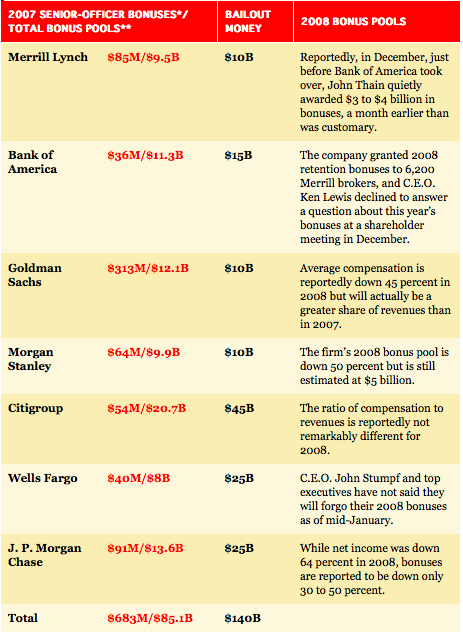
The frightening this about this table isn’t lavish CEO pay after record bank losses, nor the 9-figure scale of the payouts, but just how closely the bailout money matches the total bonus pool in almost every case. Granted, base compensation in investment banking is nearly equivalent to the minimum wage, but there are a lot of people – roughly 3.6 million in America alone – that would jump at the chance to make $150,000 for 90 hour work-weeks, if only they could…

finance & economics, financial crisis, in other words »

[25 Jan 2009 | Comments Off | ]
mad money

For nearly a quarter century, Milton Friedman’s monetarists and their acolytes at the Federal Reserve have pursued American prosperity on the assumption that the sheer quantity of money in the economy, along with the degree to which it turns over annually, are the principal levers shaping macroeconomic fundamentals. For the better part of the 20th century that assumption held true as money supply was carefully managed, rising when the economy needed a boost and contracting when it was overheating.
The theory draws its roots from a colossal failure by the Federal Reserve during the Great Depression.

finance & economics, financial crisis, in other words »

[22 Jan 2009 | Comments Off | ]
black (scholes) hole

Scientists and market commentators have long been aware of the susceptibility of the markets to any single investment philosophy. The rise of early program trading contributed to the historic one-day loss of nearly 23% on Black Monday in 1987. Recent experiments with risk securitization may cost trillions of borrowed dollars to unwind and decades to fully digest.

financial crisis, in other words »

[16 Jan 2009 | Comments Off | ]
the end of wall street

The past, present, and future of Wall Street according to its unofficial biographer…

financial crisis, history & society, in other words »

[9 Jan 2009 | Comments Off | ]
originative sin

The latest in a long series of articles on the Rational Post sharing a common refrain: those who forget economic history are condemned to repeat it…
Originative sin: the future of banking
By John Plender at FT.com, January 4 2009
For the late John Kenneth Galbraith, an acute observer of market folly, finance and innovation were fundamentally incompatible. Every new financial instrument, he said, “is, without exception, a small variation on an established design, one that owes its distinctive character to the … brevity of financial memory”. The world of finance “hails the invention of the wheel over and over again, often in a slightly more unstable version”.

finance & economics, financial crisis, history & society »

[8 Jan 2009 | Comments Off | ]
the end of 20th century finance

A eulogy for 20th century finance by one of its greatest poets…
The End of the Financial World as We Know It
By MICHAEL LEWIS and DAVID EINHORN
Americans enter the New Year in a strange new role: financial lunatics. We’ve been viewed by the wider world with mistrust and suspicion on other matters, but on the subject of money even our harshest critics have been inclined to believe that we knew what we were doing. They watched our investment bankers and emulated them: for a long time now half the planet’s college graduates seemed to want nothing more out of life than a job on Wall Street.

finance & economics, financial crisis, history & society, in other words »

[2 Jan 2009 | Comments Off | ]
princely finance

This brief history of regal extortion draws some parallels to today’s “sinister” Federal Reserve, though the links are less tenuous than Dr. Hoye and others often suggest…